

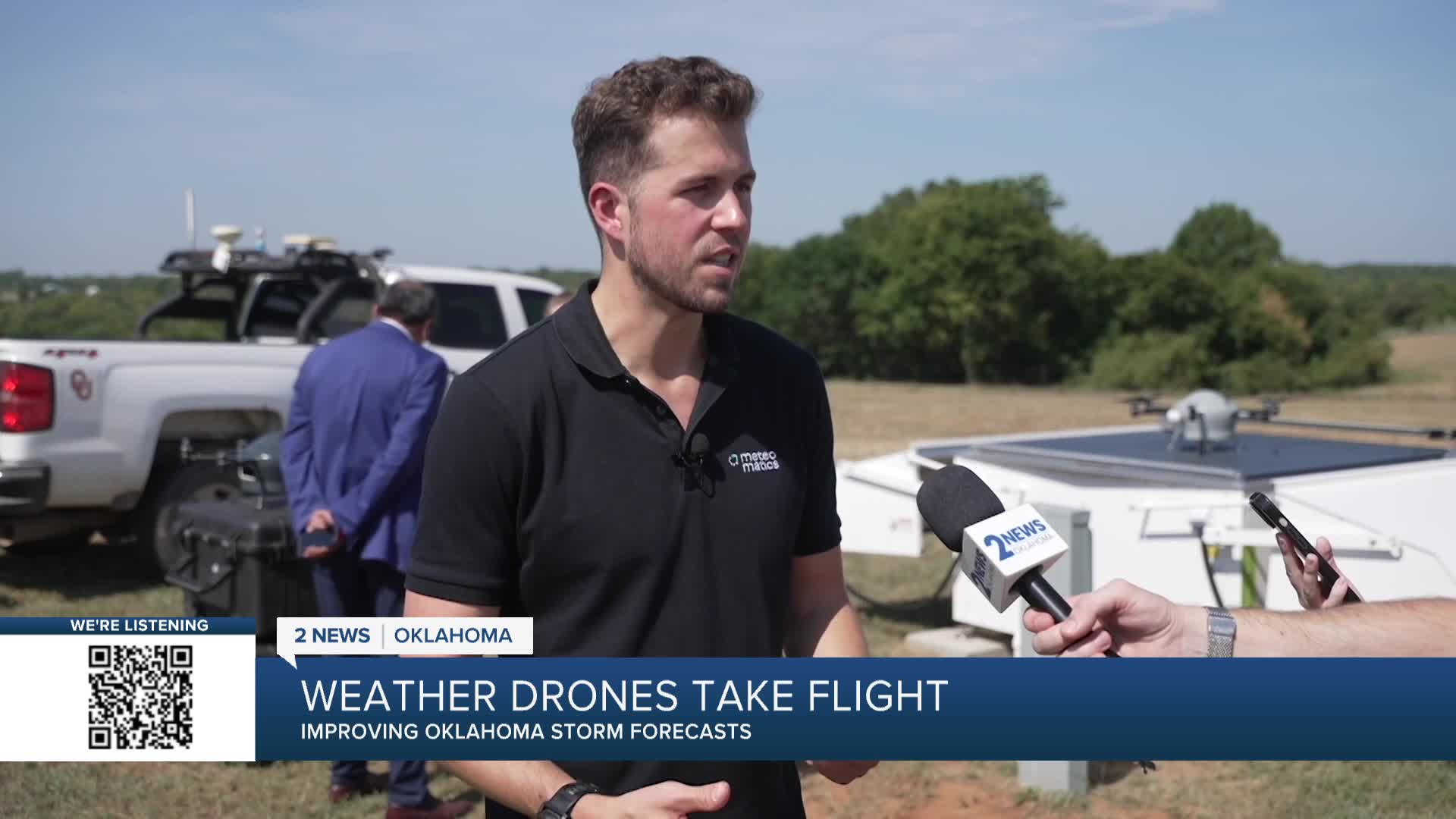


NORMAN, Okla. — Measuring Oklahoma's weather is reaching new heights. On Thursday, researchers from both public and private groups came together to reveal a decades-long effort to put a variety of critical weather-monitoring drones up in the air.
Meteomatics is one of the drone-makers involved in this initiative. Brad Guay, their government solutions leader said, “it's just like a weather balloon. It's measuring temperature, humidity, wind, and pressure just straight up and straight down. So, it's the most boring profile you could imagine, but the data is pretty exciting for the forecasters”
WATCH: Critical Weather-Monitoring Drones Take Flight Over Oklahoma:
This is exciting because Meteomatic’s drones and others showcased at the test site near Purcell are much more versatile than balloons or surface-based instruments.
Mesonet sites only measure up to 10 meters in height whereas these drones can make numerous observations up beyond a kilometer in the atmosphere.
They can be released at twice the vertical speed of weather balloons and with greater frequency throughout the day. Better, faster, and more frequent data gets ingested into computer models, making them more accurate for meteorologists to use.
“What we've already seen is that's able to improve the lead time on thunderstorm development forecasts as well as predicting some more mundane things like when the fog will lift that might affect things like solar energy generation or if flights can take off and land at the airports,” said Guay.
These drones will soon show up at the Bixby Mesonet site in partnership with OSU. More locations are planned for regular drone releases throughout Oklahoma creating what is being called the 3D Mesonet by adding vertical layers to the state's dense network of weather observation.
OU researchers like Tyler Bell developed the CopterSonde to better forecast dangerous weather. Bell said, “So by doing this research and tailoring it towards severe weather, we're also able to fly in all the conditions below that. We can go anywhere from freezing weather to incredibly hot weather like today. We can go from anywhere from no wind like today to, Cat. 1 hurricane-style wind. So that's 60 to 70 miles per hour.”
Charged on their landing pads, these drones will eventually become fully autonomous. This will allow for a large-scale network to operate seamless day and night to better understand this vital gap in observation where severe weather takes shape.
"When tornadoes form, that happens in the lowest few thousand feet of the atmosphere,” said Guay. “It's kind of like the weather kitchen a little bit where the atmosphere starts cooking, and it's pretty dynamic.”
It is this boundary layer of the atmosphere where new insights hope to be gained by scaling up these drone flights through Oklahoma and throughout Tornado Alley.
Stay in touch with us anytime, anywhere --
- 2 News Oklahoma on your schedule | Download on your TV, watch for free. How to watch on your streaming device
- Download our free app for Apple, Android and Kindle devices.
- Like us on Facebook
- Follow us on Instagram
- Watch LIVE 24/7 on YouTube
