

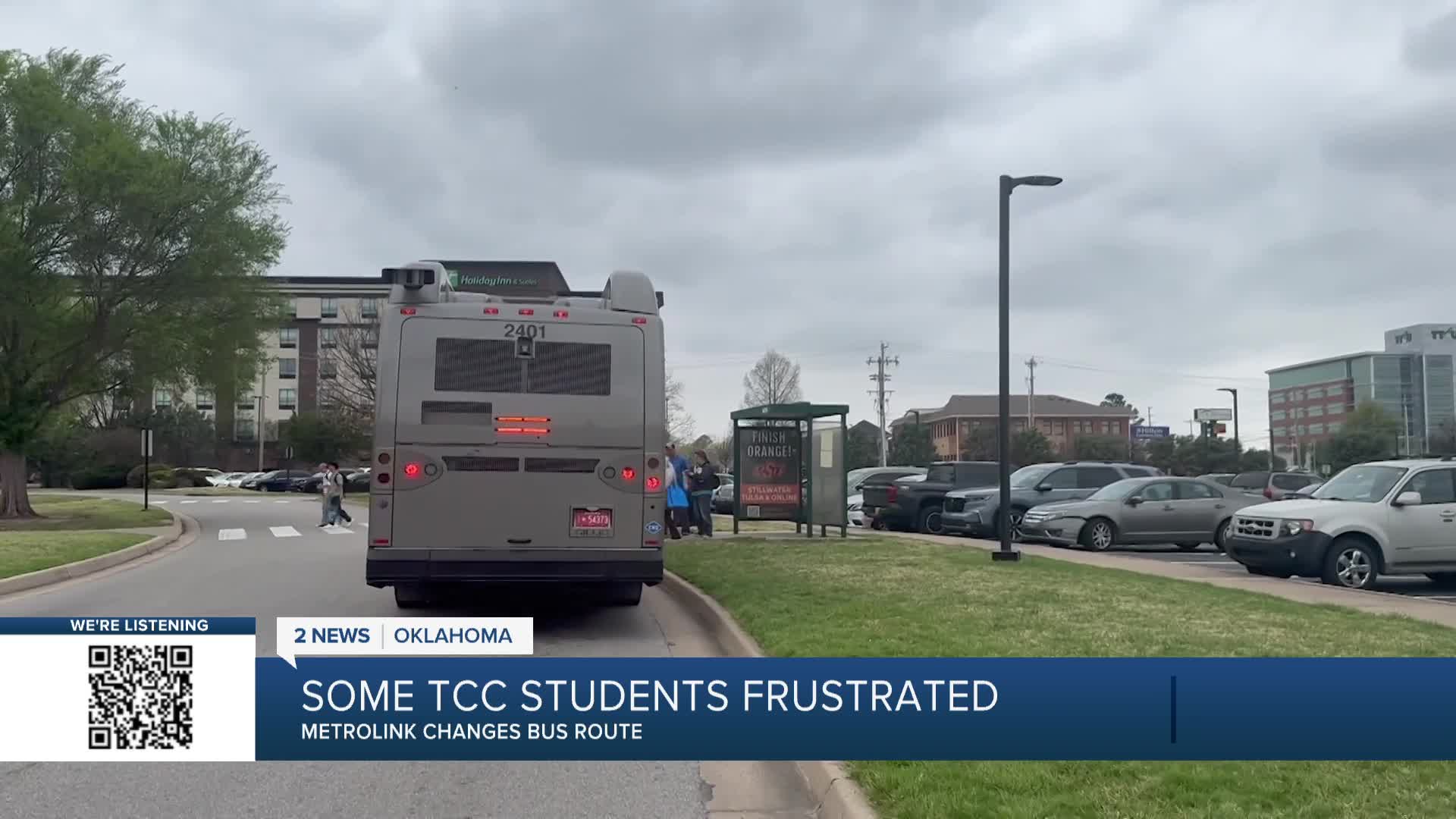


TULSA, Okla. — Crystle Lacroix is an instructor at the Tulsa Community College Southeast Campus. She lives downtown, so she rides the bus to work.
"I love public transit," Lacroix said. "I don't have a car. That's kind of an active, conscious choice. And I enjoy riding the bus."
John Dickerson, Jr., also rides the MetroLink for work.

"It's reliable," Dickerson said. "Even when it's not on time, it's still reliable. You can count on them to be there."
Unfortunately, the bus won't be stopping at TCC starting April 12, after the service announced route changes on the south end of town.
WATCH: 'We keep the bus system going': Riders frustrated with MetroLink changes:
"The bus is going to stop at the Walmart sub hub on Memorial, the Woodland Hills Walmart sub hub," Lacroix said. "And we're being told we have to get off that bus and take the MicroLink instead."
"They need to realize, no riders, no drivers," Dickerson added. "We keep the bus system going."
Instead of being able to ride the bus on the 250 route all the way to campus, students and faculty will have to get off and schedule a MicroLink, basically, the transit's rideshare, to get to campus.
"It's an easy fix. Without getting off the bus to book a bus to go further," Dickerson said. "Micro is nice, but it's not always on time."
So Crystle reached out to the 2 News Problem Solvers.
"Decisions that are made for us without talking to us are not helpful," Lacroix said. "Since I'm not able to have that so far largely, talking to you is a great opportunity."
2 News Oklahoma reached out to MetroLink, asking about the changes. In a statement, CEO Scott Marr said:
Due to consistently low ridership, Route 250 has not met the performance standards necessary to justify its current level of service.
Like many transit systems, demand patterns have shifted in recent years, with some routes experiencing significantly lower usage. Research shows that low-ridership routes can be costly to maintain and may require agencies to adjust or reallocate service to better match community needs and travel behavior.
As a result, service changes to Route 250 are being implemented to improve overall system efficiency, reduce underutilized service, and reinvest resources into routes with higher demand or greater community impact. On average we had 5 customers per day that rode to TCC. For those reasons we've added a Micro Transit zone that will cover this area. Micro Transit will offer curb to curb service when the customer requests their ride via mobile device, computer or calling into the call center. Micro Transit has been a tremendous success since it began almost 3 years ago. In the event we see increased ridership we will adjust the service needs.
We understand that any service change can affect riders, and we remain committed to working with the community to provide alternative options and maintain access to essential destinations."
"And it's not just the students at TCC that'll be impacted by these route changes. Right down the street, the Ernest Childers VA Clinic will also be impacted by that bus stop. 93-year-old John Hairston, a Korean War vet, says that could cause problems.
"It creates a tremendous hardship to not have that available," Hairston said.
Both Dickerson and Lacroix tell 2 News that they still plan to ride the bus after the changes, but hope that by sharing their concerns, MetroLink will consider revising the routes.
Stay in touch with us anytime, anywhere --
- 2 News Oklahoma on your schedule | Download on your TV, watch for free. How to watch on your streaming device
- Download our free app for Apple, Android and Kindle devices.
- Like us on Facebook
- Follow us on Instagram
- Watch LIVE 24/7 on YouTube
