

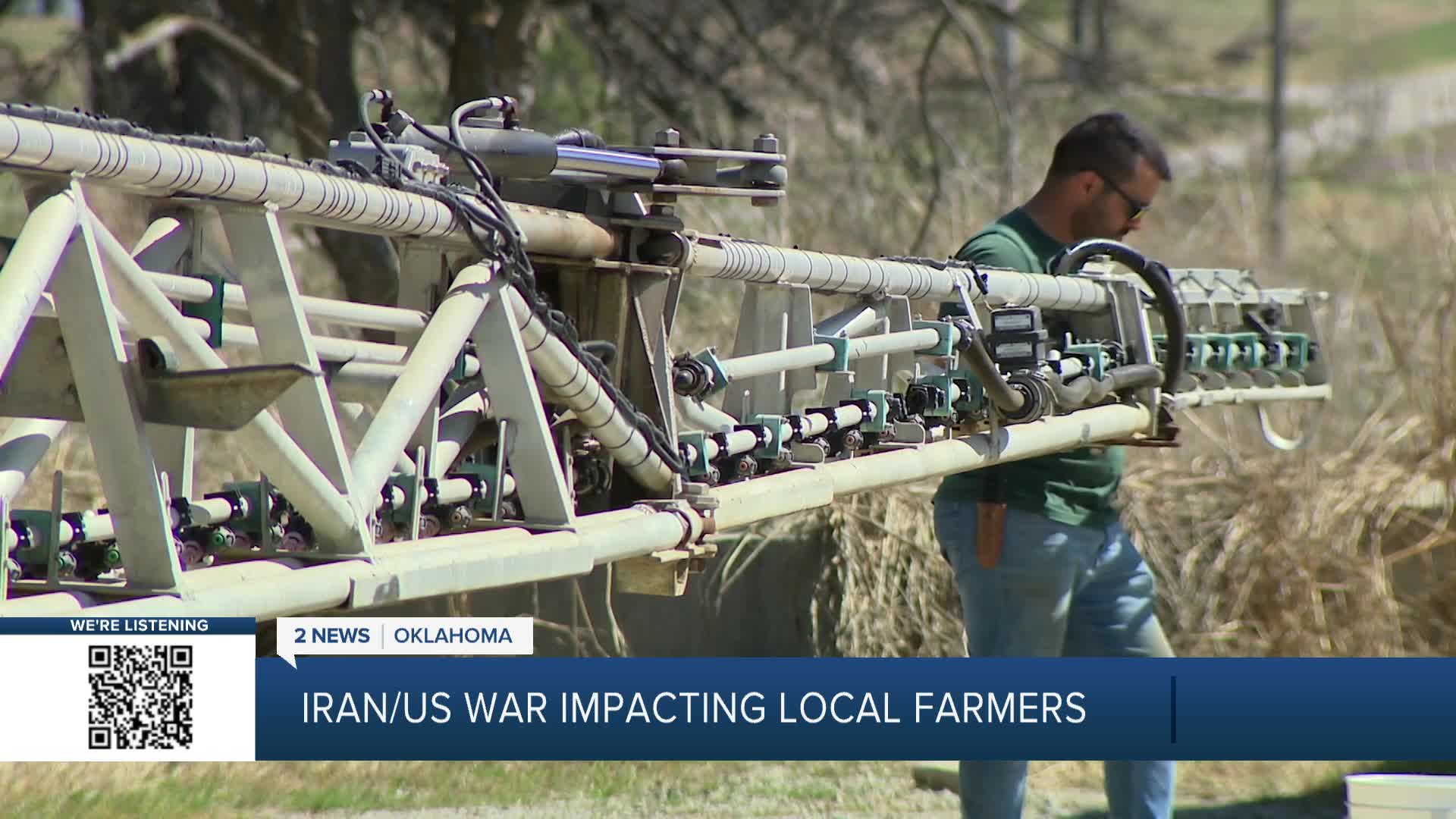


TULSA, Okla. — As the war in Iran continues, local farmers are feeling the ripple effects of supply disruptions in the Strait of Hormuz.
The American Farm Bureau reports that approximately 50% of global fertilizer exports pass through the Strait, impacting farmers as they prepare for spring planting.
2 News Oklahoma listened to one Green Country farmer, Tommy Salisbury, who is scrambling to stay afloat as fertilizer prices rise.
WATCH: Fertilizer prices soar amid Iran war, leaving local farmers scrambling
"This is the time we use the most fertilizer," Salisbury said. "We grow soybeans, Milo, and wheat."
Prices for urea fertilizer, the most common crop nutrient, climbed almost overnight. Before the war, Salisbury said fertilizer cost around $625 per ton. When the war started, it shot up by $150, making it almost $800 a ton.
"Urea fertilizer has gone up roughly about $150 a ton, and we immediately saw it, after the conflict in Iran," Salisbury said.
Related>>>WHAT'S NEXT: OU Professor & Middle East expert shares insight on Iran
While the U.S. does not import much from the Middle East, the Farm Bureau says the fertilizer market is global, meaning international shocks still drive prices here at home.
"Most of the fertilizer exports in the world do come through the Middle East over there, but for us locally, it's very confusing and almost discouraging as farmers when we can't even make ends meet the way it is, and as soon as something happens, we're the first ones to get the brunt of the change," Salisbury said.
Salisbury farms 3,200 acres in northern Green Country.
"So you know a ton would get us 10 acres," Salisbury said.
Bringing Salisbury's fertilizer total to almost $248,000 in urea alone. He said his costs soar while farm income stays flat.
"When inflation goes up, the retail businesses increase their commodity prices or what have you on the end to make up for that price difference in farming, we don't have that option," Salisbury said.
He worries if prices keep climbing, the future of agriculture will be on the line.
"It's not sustainable for the next generation to continue farming unless something changes," Salisbury said.
Still, giving up is not in a farmer's DNA.
"Overall, it's just hard to make ends meet, but we're farmers, we're not going to give up, we're going to keep going. The world needs to eat," Salisbury said.
Stay in touch with us anytime, anywhere --
- 2 News Oklahoma on your schedule | Download on your TV, watch for free. How to watch on your streaming device
- Download our free app for Apple, Android and Kindle devices.
- Like us on Facebook
- Follow us on Instagram
- Watch LIVE 24/7 on YouTube
