



Friday night's hailstorm over the north side of the Tulsa metro area was among the worst many had seen in their lifetime. Cars, roofs, and windows were damaged by hail at least the size of golf balls.
So, how do we get hail like this?
WATCH: What makes hail so large?
It starts with a strong updraft into the storm. This is what builds up the cumulonimbus cloud. In a supercell, the downdraft is separated from the air rising into the storm, allowing it to be sustained and strengthened.
This updraft lofts raindrops high up in the storm cloud where temperatures are below freezing, allowing the drops to freeze into small bits of ice. These early-stage hailstones are then thrust about in the cloud due to strong vertical and horizontal winds, gathering more water on the ice, which then freezes around them to make the hailstones grow.
Finally, the hail reaches a weight that the updraft, the rising air into the storm, can no longer support it. That is when gravity takes over and down comes the hail.
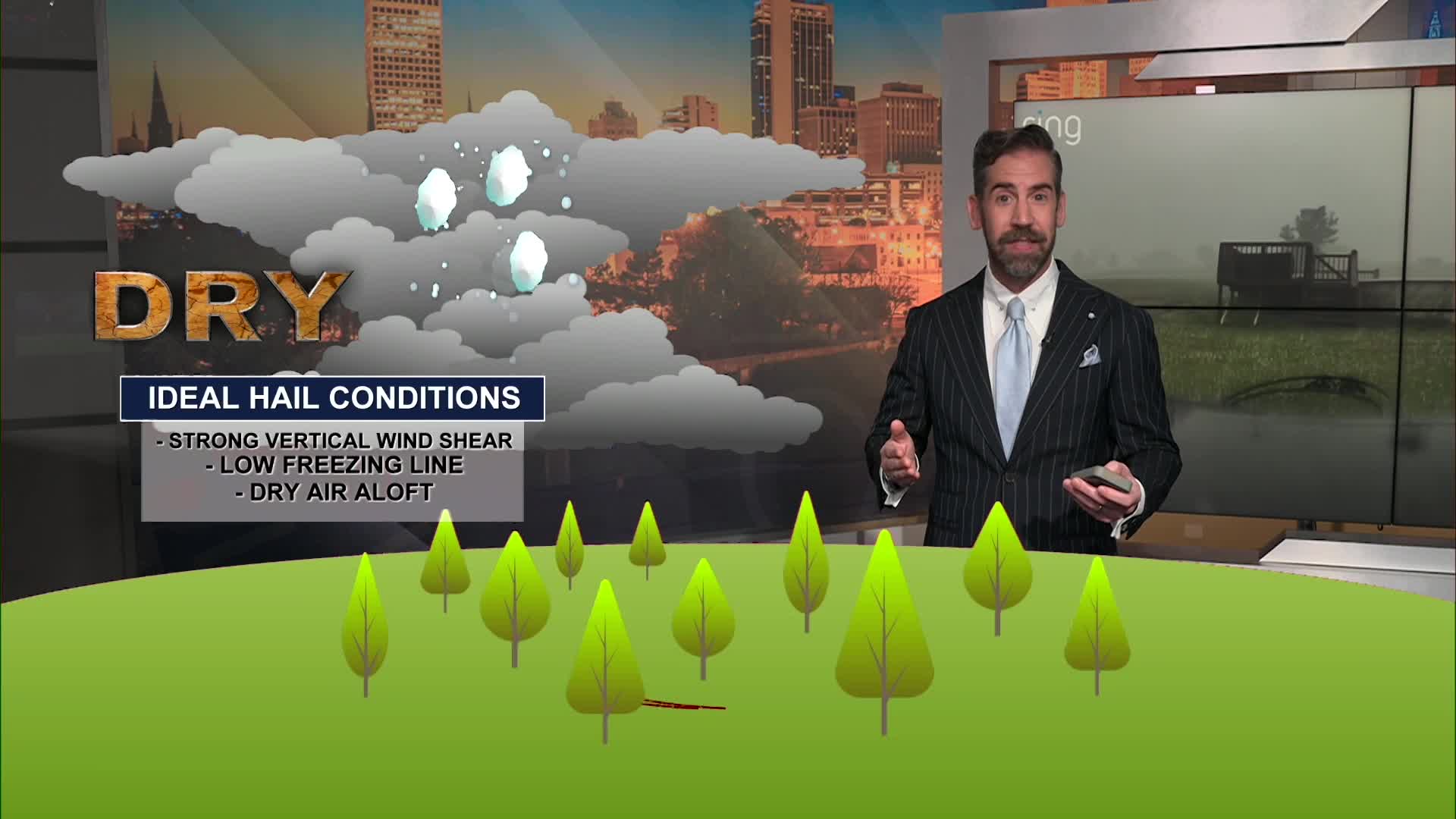
Several factors make hail larger beyond just the strength of the updraft. Strong vertical wind shear makes the storm rotate and better organized, keeping hail aloft longer and hail generation lasting for more time.
A lower altitude freezing line allows for less melting time before the hailstone reaches the ground. However, too low of a freezing line limits how strong a storm can be in the first place.
The optimal altitude for 32° is about 1 and a half to 2 miles above the surface. Finally, dry air minimizes the melting of the hailstone. Too much water can make the hail melt faster as it falls.
Air with less moisture and rain allows for more evaporative cooling from the hail and makes it reach the ground larger. This is why hail that falls near the rotating updraft of a storm (often where tornado formation occurs) is where the largest hail is found, since all the rain is lofted or moved away from this space.
This allows the heavier hailstones to overcome the rising air and fall here.
Remember, you can share your storm photos with us. Just e-mail your best shots to weatherpics@kjrh.com.
Stay in touch with us anytime, anywhere --
- 2 News Oklahoma on your schedule | Download on your TV, watch for free. How to watch on your streaming device
- Download our free app for Apple, Android and Kindle devices.
- Like us on Facebook
- Follow us on Instagram
- Watch LIVE 24/7 on YouTube
