




TULSA, Okla. — Tulsa's Greenwood District, known to many as Black Wall Street, was a flourishing African American community during the early 20th century.
Thousands of African Americans called this area home, and hundreds of Black-owned businesses thrived.
WATCH: Tulsa's Black Wall Street: The rise and devastating fall of America's most prosperous Black community:
The community's origins date to 1906, when O.W. Gurley established a presence in the area. Gurley bought land and sold parcels to other African Americans, sparking rapid business development.
"The Greenwood kicked off in about 1906 by fellow name O.W. Gurley that established a presence here. Bought some land, sold land, parcels of land to other African Americans and the businesses just proliferated after that. It became kind of a commercial hub in segregated Tulsa," said Hannibal B. Johnson, Black Wall Street historian.
Johnson explains that the Frisco tracks served as the dividing line between white and black residents in Tulsa.
Before the Tulsa Race Massacre in 1921, Greenwood was incredibly prosperous. African Americans owned over 300 businesses, including banks, hotels, restaurants, and professional services.
The area earned its famous nickname from educator Booker T. Washington, who recognized the community's exceptional wealth and prosperity.
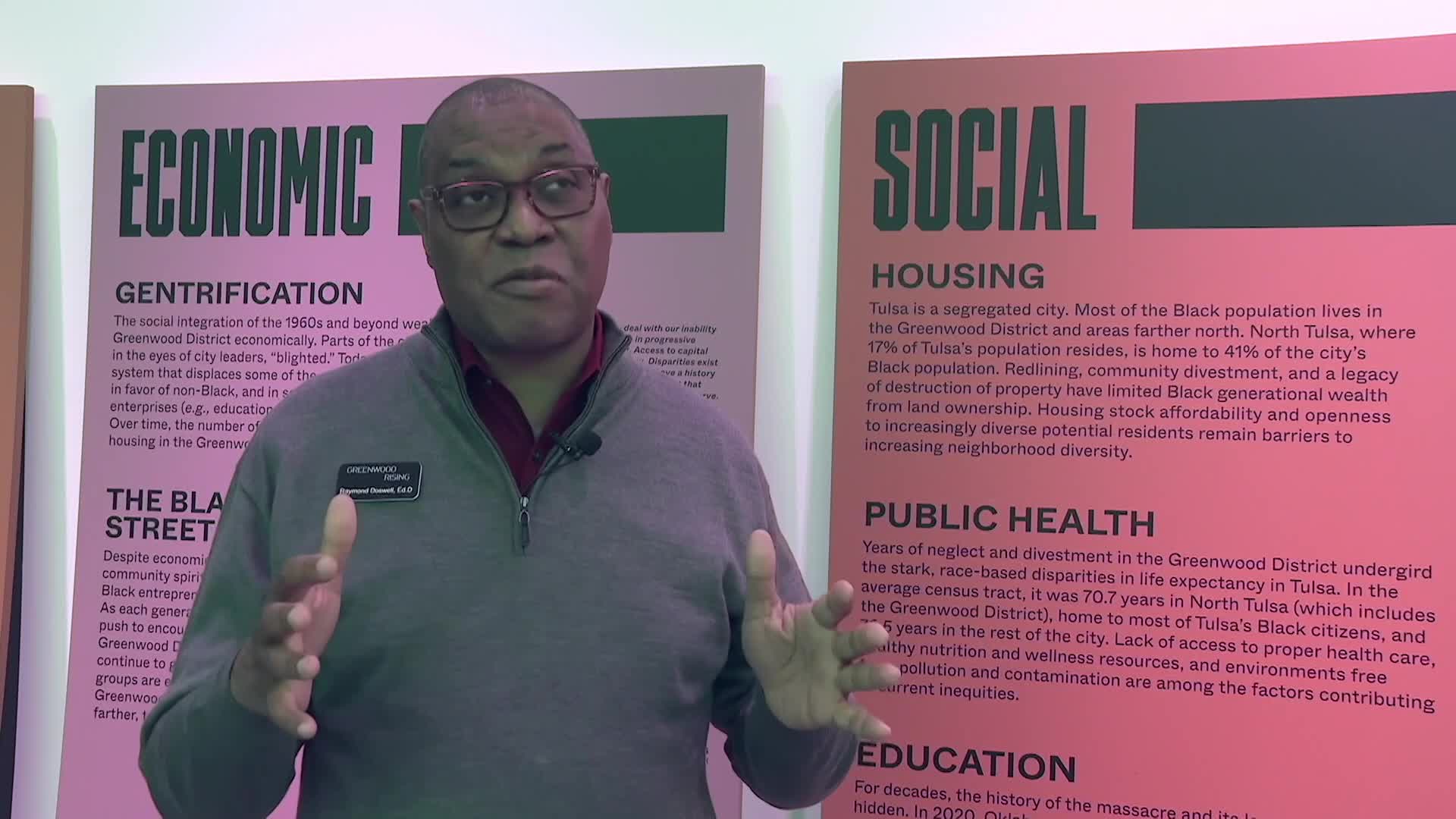
"The great educator Booker T. Washington is credited as suggesting that this area was kin to a 'Negro Wall Street'. Not necessarily stocks and bond trading but the amount of wealth, affluence, and prosperity that was happening in the area," said Raymon Doswell, Greenwood Rising executive director.
About 12,000 people lived in Greenwood, and their wealth and self-governance spoke volumes across the country.
By 1920, racial tensions were rising nationwide, with major race riots occurring in Houston, Texas, and East St. Louis, Illinois, in 1917.
"Houston, Texas, has a major race riot, East St. Louis, Illinois, has a major race riot, and those are in 1917. And in 1919, the so-called Red Summer, there were several race riots that broke out in many cities across the country. Coast to coast frankly," Doswell said.
In 1921, nearly everything Greenwood residents had built since the late 1890s went to ashes. The destruction stemmed from an incident between two teenagers on a downtown Tulsa elevator.

Tulsa Race Massacre Centennial
"The elevator was operated by a white girl named Sarah Page. Something happened on the elevator that caused it to jerk or to lurch. Dick Rowland bumped into or stepped on the foot the girl, Sarah Page. She overreacted and things just spun out of control," Johnson said.
Over two days, rioters destroyed every building except one — the Vernon A.M.E Church. Hundreds of African Americans died, and some remains are still being found today.
"The cemetery at 11th & Peoria became kind of a focal point of where people thought mass graves might be. That was also the so called 'Potter Field' for African Americans as well. So if you were poor and you didn't have any family, that's where they would bury you, and it usually would be an unmarked grave," Johnson said.
Despite massive destruction, the resilient community partially rebuilt within a year. 80 businesses reopened by 1922. However, the economic impact was permanent — wealth accumulated over decades but was never fully recovered.
According to reports, over 1,400 homes and businesses burned to the ground in the summer of 1921 after the Tulsa Race Massacre.
This story was reported on-air by a journalist and has been converted to this platform with the assistance of AI. Our editorial team verifies all reporting on all platforms for fairness and accuracy.
Stay in touch with us anytime, anywhere --
- 2 News Oklahoma on your schedule | Download on your TV, watch for free. How to watch on your streaming device
- Download our free app for Apple, Android and Kindle devices.
- Like us on Facebook
- Follow us on Instagram
- Watch LIVE 24/7 on YouTube
