

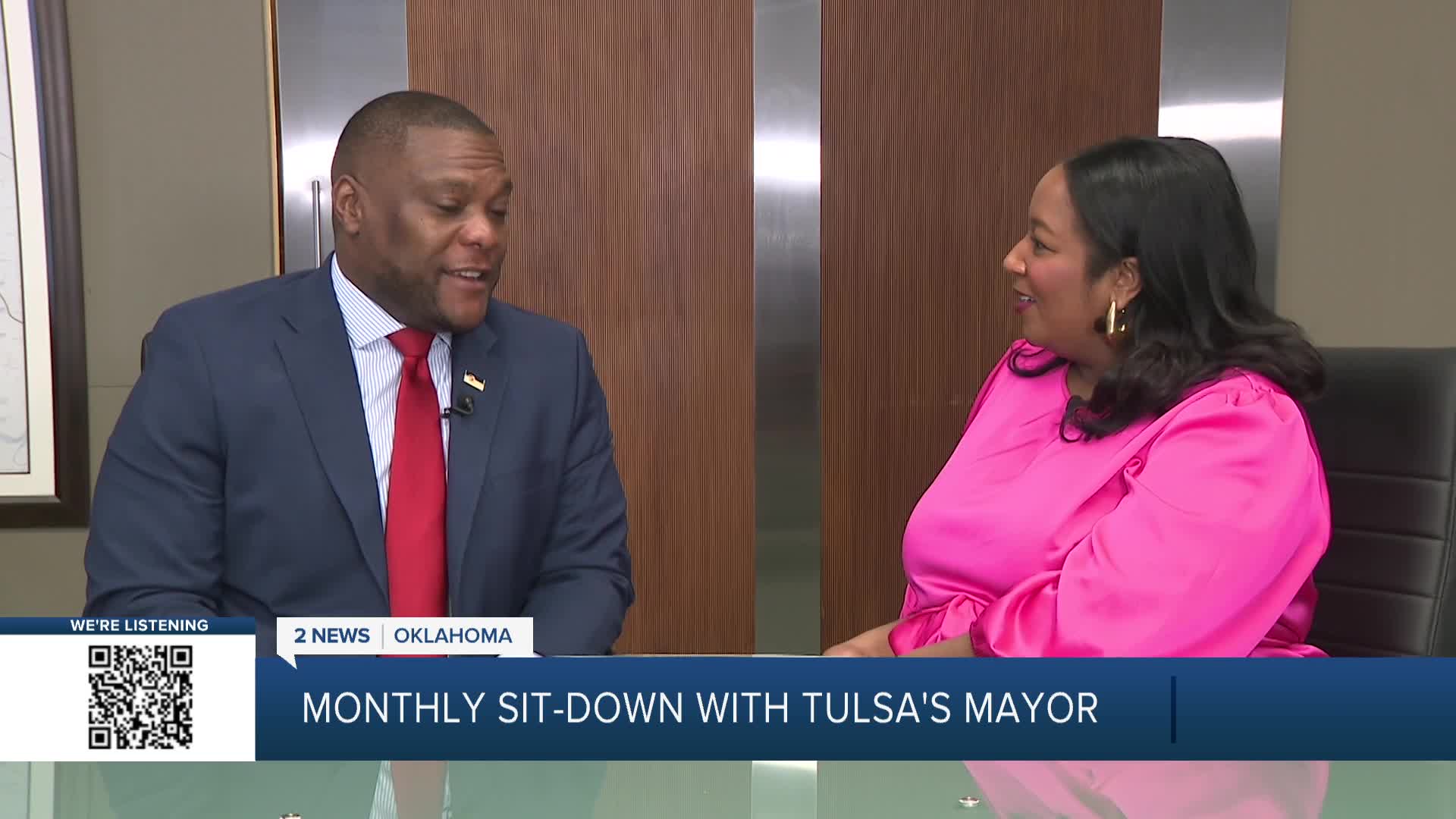


TULSA, Okla. — In our monthly segment with Tulsa Mayor Monroe Nichols, we discuss the $47 million for affordable housing, development across Tulsa, and a new initiative to get more students enrolled in Pre-K.
WATCH OUR INTERVIEW:
Here is the full interview transcript between 2 News Anchor Naomi Keitt and Tulsa Mayor Monroe Nichols:
NAOMI: I want to get started with housing. I know that there was a big announcement, $47 million from Improve our Tulsa. Talk to me about what that means.
MONROE: Yeah, it means that we're going to, you know, get on with the business of getting affordable housing out of the ground. You know, we have a goal of getting 6000 new units from the day I took office until 2028. And right now, if you look at our housing tracker, I think we're about 1000 or so in on the affordable side. The $47 million matched with private and philanthropic dollars will grow to a fund of about $125 million that's going to go directly into the development of affordable housing. It's going to be a really busy next three years in Tulsa as we really start to catch up on where we're behind on the affordable housing stock.
NAOMI: Where are these houses going to go, and is this to make sure that people have some place where they can actually live? I know that there's a lot of like luxury development downtown.
MONROE: Yeah, so you'll see it across the community, and you'll see a mix of both kind of a single-family, home type of structure, but also a multi-family as well. We have some really big, um, affordable housing developers that are in town, do a lot of multi-family. Mercy Housing is one of them as an example, but you'll see it across the community. And, and what I think people should think about, we certainly think about this in the context of getting some of our folks who are on the street off the streets. But when we talk about affordable housing, we're talking about the over 50%, about 50% of people who are cost burdened right now in Tulsa. So we're talking about teachers, um, we're talking about young people who are just getting their career started. Uh, we're talking about all sort of, uh, public service folks, many of, many of them even work here at the city who just need more affordable options. Uh, so it's not just about the homeless side. And so if you think about that. There's not a corner of the city that couldn't use more affordable housing stock, and so the focus is going to be to make sure we deliver all across the community.
NAOMI: I know you were talking also about our unhoused neighbors. I know Safe Move Tulsa needs that funding as well. Does this funding go with that, or is this a different entity?
MONROE: I always think about housing and homelessness being related but almost being cousins, uh, and so, you know, the housing strategy that we have is going to help our work as far as getting people off the street because the more stock we have, the better off we are. We're getting people where they need to be, but they're quite separate. Um, part of a similar strategy but not the same strategy. And so the housing, uh, the more we do there, the easier the homeless work becomes. Uh, the better job we do on the homeless front, the more we have to do on the housing front to make sure we can, we can keep up because again this is not just our housing work. It's not just about those on the streets. It's about everybody who needs affordable options. And then we also know, uh, the market study told us we also need options on the higher end, so we need housing at all levels. And so not all of it is focused so much on. Um, what we would consider to be the unhoused population, it's really, it really is across the board. And so safe move as a strategy is really about, um, ending street sleeping, getting rid of encampments, making sure we're getting people instructions, and making sure we're giving them the kind of support that they need, um, so the two do go hand in hand in some ways, but I think you can think of them. As kind of supporting strategies, not necessarily all the same thing.
NAOMI: So, the funding needed for safe move is that money that is still needed to be able to continue that work?
MONROE: Absolutely. So, you know what, what we begin to talk about here is, you know. Since we don't have a long term funding solution yet, um, I've made the commitment to bring some of our fund balance to make sure we can bridge safe move, um, as the council continues to think about, you know, how do we might, uh, address some of our revenue challenges that we, we have in the city, uh, and so we've provided some stability for safe moves. It's going to be up to the council to appropriate the money, but my budget proposal this year. It is going, you know, match our 1st 6 million. This 6 million will come out of fund balance. So, for the first time it'll actually be our, our city resources going into it, um, and so I'm excited about that. That'll bridge some of the gap. We're still going to have to have a conversation about how we do it long term, um, but, but we'll be able to complete kind of phase one of safe move, move us into phase two, and at that point we'll have to have a real important conversation as a community about how do we. How do we fund it?
NAOMI: Going back to those 6000 units that we want here in the city, why is that necessary for Tulsans, for people who live here?
MONROE: It's just the number, right? The number, uh, tells us we are that deficient, probably a little more than that when it comes to affordable housing. Again, the, you know, the stats tell us we're about 50% of folks who are cost burdened, mean they, they're spending more than 30% of their income on housing costs. That is really tough when you think about the economy, when you think about education. One of the reasons we got into this work. was the data that showed us that kids who were in families that have been evicted were 50% of them were chronically absent for the first month, 70% after the first year. And so, this is also about family stability. It's about academic outcomes. It's about all those things, um, and so, you know, the 6000 units gets us to a place where we are starting to catch up. And the big thing for us was if you don't have a number that you're trying to hit, how do you think about your internal practices that have to, to, to get fixed? As an example, the money's great. The money's critical, can't do it without it, but you can have all the money in the world. If you don't fix your internal practices, you're not going to be able to do anything with it. So, our housing acceleration team is working where every department that's touching a permit is working on complex projects to get them out the door Hilltop Project was one of those. Uh, we have our pre-approved plans, uh, our T Town catalog that is almost finalized and so, it'll help get uh structures to market a lot quicker. We have our community builder program. We're fast tracking people who are doing some of the more neighborhood-based house flipping at an affordable rate to get them, uh, sped through the permit process to get those structures online, and the council, along with the, uh, some of our team in the mayor's office is working on a new ordinance to allow us to take advantage of state law that will help us clean the titles on, uh, blighted properties that are not owner occupied that will allow us to turn those into affordable units and so. You know, it's more than just the money. Money is critical. Like I said, can't do it without it. But we also have taken a good hard look at our internal practices as well.
NAOMI: I want to talk about development. When the news about IKEA coming to town, everyone lost their mind, including me. Talk to me about what that means for the city.
MONROE: Well, I think it means we're going be a well-furnished city here pretty soon. Everybody's going to be over there shopping. Um, you know, obviously a, a brand like IKEA is a really, really big deal, as evidenced by all the news office because I think, I was like, man, I think that's the biggest news that we've had in my time in office of all the things we've done at IKEA coming it's the biggest thing, um, but, but great from an economic development standpoint. Uh, I think it's going to really also help continue to build, uh, Tulsa Hills, so people are continuing to come, uh, out there, um, but you know, I've seen numbers that, you know, are looking about 30 million in sales, and, you know, so we'll benefit from that as a city. Um, but I think the big thing about that whole story, which I think is really cool, it's about a 3-year process to get IKEA here actually predated me in office, and so it's been work by folks here at the city at partner Tulsa that have been working for 3 years to make that happen, and now we have the first IKEA in the state, which is pretty cool.
NAOMI: Knowing that IKEA could have chosen Oklahoma City, but they chose to come here to Tulsa. What does that mean to you as mayor?
MONROE: Um, I think it, I think it means that, you know, we have a really, really strong retail market here in, in this community, and I think it also means we have folks who regionally, um, you know, would, would come to Tulsa maybe over other places. I imagine. The folks from Arkansas and Missouri and all that, Kansas will probably come in and, you know, uh, shop at IKEA. So, I think it's also we probably are better servicer of the region, uh, probably helps us out quite a bit. But I think it's a, a strong show that IKEA and a lot of other places are really bullish on the Tulsa economy, uh, and we are too.
NAOMI: I know we covered a story yesterday doing a walkthrough of the downtown grocery store. That's another big development project too.
MONROE: I'm excited. I mean, it's been a long time coming. Um, AJ and I actually played football together.
NAOMI: Oh really? Oh, cool.
MONROE: So it's cool to see him, uh, doing what he's doing, you know, his story, our store, uh, North Peoria, and that felt, that filled a really important need. Downtown's filling a really important need. He's a great entrepreneur, hard worker, and I'm really excited about the grocery store for two reasons. One, it's great for downtown and, and all that, but 2, I live very, very close, so it'll now be my closest grocery store. I love that. I love that. So selfishly, I'm very excited. So personally, I'm glad that you have someplace to shop. That's right. Uh, both as mayor and just as Monroe the person, very excited about it.
NAOMI: I know some of the people we talked to yesterday said, I'm just glad I'll have someplace to walk and go. Don't have to go get in the car and go to, to Brookside or any place around here, right?
MONROE: And you know, you know, you travel around the country, um, cities, you know, our size and bigger, you know, you see those things all the time. And so, as we have folks who are coming in who are moving here from other places or even folks who are visiting. You know, I, I think it's, it's a sign that Tulsa's starting to, to grow in the kind of direction that we got, we got people, we got excitement downtown and we've got more people living downtown. Uh, and so the grocery store is going to be a great asset to the community.
NAOMI: I want to talk about education. Um, I know that you all came out with the “Pre-K for all initiative.” I want to ask first though about these administrative layoffs at TPS. Do you have any thoughts on that? 50 positions?
MONROE: Yeah, I mean, I don't know a ton about it, um, but, but what I know is, is, you know, any of us who are running, you know, big public institutions, there's a reality about, you know, resources and the impact of having fewer of them or having, you know, costs that are escalating on you. Anything that people feel as individual or companies are feeling outside, you know, governments feel it also, uh, and so what I know is there's going to be a lot of folks who might be, you know, may have had their positions eliminated, but I think they're going to be folks who are going to continue to contribute to the community. Um, so I, I, I, I think everybody will hopefully be able to, be able to bounce back. Um, but I know it's not an easy decision to make. And so, um, I appreciate so much Doctor Johnson's leadership, but making a decision like that is not easy. Uh, and so my hope is, is that the folks I know, and I do have some friends who were impacted by it, uh, that we help them land well, um, because it's a bunch of people with a whole bunch more to give to this community, and I think there's other ways in which they can serve, and we look forward to helping them connect to them.
NAOMI: The Pre-K initiative, talk to me about that.
MONROE: So, I believe that pre-K is, you know, a critical start. Um, all the data suggests that school readiness is the greatest indicator for, you know, how well you'll be able to read in 3rd grade. Third grade reading is critical on, you think about middle grade math and science, that's critical to graduation rates, and so it all starts at pre-K. And so, Pre-K Tulsa, you can go online, you know, you can put where you live, it'll connect you to all the options around you. You can, it, it makes it a lot easier. I have a 17-year-old. He was going to Pre-K a long time ago. It would have been nice to have something like that to help navigate those spaces when he was a, when he was a kid. But what we know, like I said, all the academic science tells us that pre-K is not just daycare. It is a critical academic year. And making it easy for parents to find options is exactly what we're doing with the pre-K Tulsa initiative.
NAOMI: Do you have any numbers on how many Tulsans take advantage of, because I know our pre-K programs across the public schools are free. Do you know how many Tulsans are taking advantage of that?
MONROE: Quite a bit, but I mean we do know there's additional capacity. Like last year with the coalition effort, um, you know, as we kicked off the Office of Children and Families, we didn't have the pre-K Tulsa deal, but it was still a focus last year. And we saw an uptick, and I think it was a little less than 1000 more kids were enrolled in pre-K. And so those things are really critical and so we do continue to have capacity. I remember at my time when I was in the nonprofit sector, um, I'm trying to recall, but I feel like there was, you know, there was decent vacancy, uh, and I think a lot of it is because pre-K for some, like I said, it seems like daycare. I know a lot of ways, a lot of parents don't know the options that exist for them. Those parents who pay for, you know, daycare from 1 to 3 may not know at 4 years old, your kid can go to school for free now. Uh, and then trying to sift through all, you know, the, you know, half day versus full day programs, all that kind of stuff can be difficult. And so that was one of the reasons why pre-K is also so important to help parents get those options at their fingertips, because we want every child who is eligible, uh, every 4-year-old in this community to take advantage of it. It's one of the, you know, Oklahoma's led the country in universal. Pre-K for a very, very long time we have to take advantage of it. I guarantee you if we do it, NAEP scores are going to go up, graduation rates are going to go up, you know, our long-term economic vitality is going to be much better. Uh, so, so I encourage all parents to do it. Don't forget your utility bill. I forgot to say it the other day. Make sure you bring your utility bill. Uh, make sure you have it handy because so you can prove, you know, where you live, your address, those kinds of things.
Stay in touch with us anytime, anywhere --
- 2 News Oklahoma on your schedule | Download on your TV, watch for free. How to watch on your streaming device
- Download our free app for Apple, Android and Kindle devices.
- Like us on Facebook
- Follow us on Instagram
- Watch LIVE 24/7 on YouTube
