

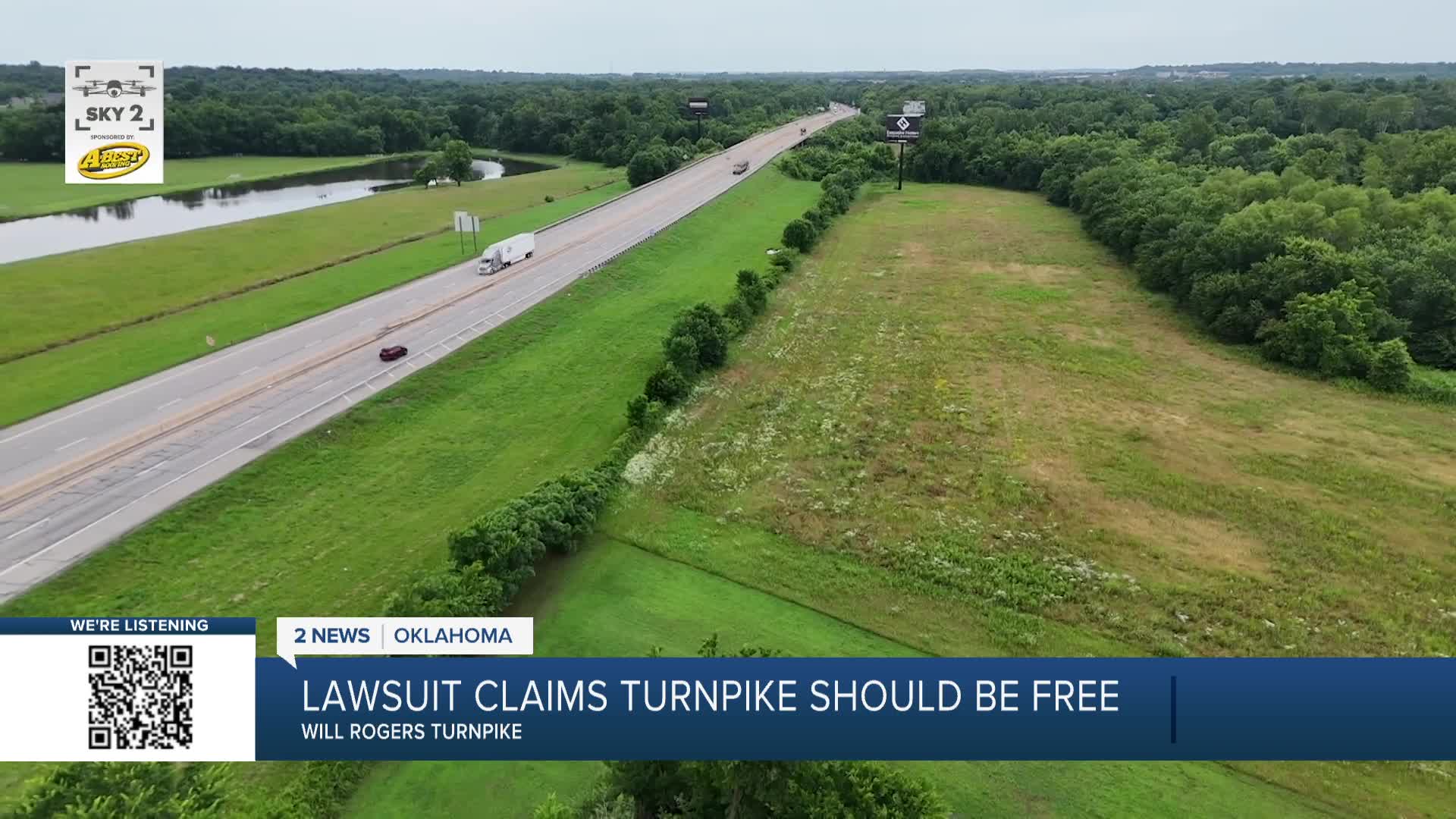


Should a stretch of the Will Rogers Turnpike—from Claremore to Catoosa—be a free road?
According to a lawsuit—yes, citing state law passed in 2000.
According to the state—no, claiming former legislators are simply misinterpreting the law.
WATCH: Lawsuit alleges Will Rogers Turnpike should be free, due to decades-old law
Former State Senate Pro Tempore Stratton Taylor long fought for frustrated drivers. He wanted that stretch of the Will Rogers Turnpike to be free.
In 2000, when plans for a free highway parallel to the turnpike came about, he felt it was a waste of money. According to an article in the Tulsa World, used as an exhibit in the lawsuit, Taylor asked then-head of the Oklahoma Department of Transportation and the Oklahoma Turnpike Authority, Neal McCaleb, to come up with a better plan.
That plan? Have ODOT lease that stretch of turnpike to the Oklahoma Transportation Commission, effectively making it free for drivers.
That plan turned into legislation, and it was signed into law. McCaleb, who has since passed away, was quoted as calling it a “win win… saving money for taxpayers as well as for the state.”
However, the law came with a contingency, says attorney Kevin Easley, Junior. The contingency was that the turnpike would be free when the Flint Road interchange was finished.
Due to a variety of reasons, the interchange took 25 years. It finished in March of 2025.
Easley’s father, Kevin Easley, Senior, was also a former legislator. He remembered that 2000 law and noticed drivers still being charged.
“They [ODOT] did not forget about this, but they were hoping we all did, and we didn’t,” said Easley, Jr.
Easley’s lawsuit claims the state ignored the law by never entering into a lease and continuing to charge drivers.
“It is a mafioso-style level of extortion and it’s unacceptable,” said Easley. “The people of Northeast Oklahoma are tired of doing business with Tony Soprano.”
Easley is seeking to have the tolls dropped and drivers paid back, but the state is fighting back. In court documents, they call the 2000 law ‘ambiguous,’ ‘legally obsolete,’ and ‘inoperative given changed circumstances and lapsed funding.’
The state also accuses Easley of attempting to ‘rewrite law and history.’
Easley says they are awaiting a decision on whether the Oklahoma Supreme Court will hear the case.
An ODOT spokesperson told 2 News via email that they do not have further comment, pending litigation.
Stay in touch with us anytime, anywhere --
- 2 News Oklahoma on your schedule | Download on your TV, watch for free. How to watch on your streaming device
- Download our free app for Apple, Android and Kindle devices.
- Like us on Facebook
- Follow us on Instagram
- Watch LIVE 24/7 on YouTube
