

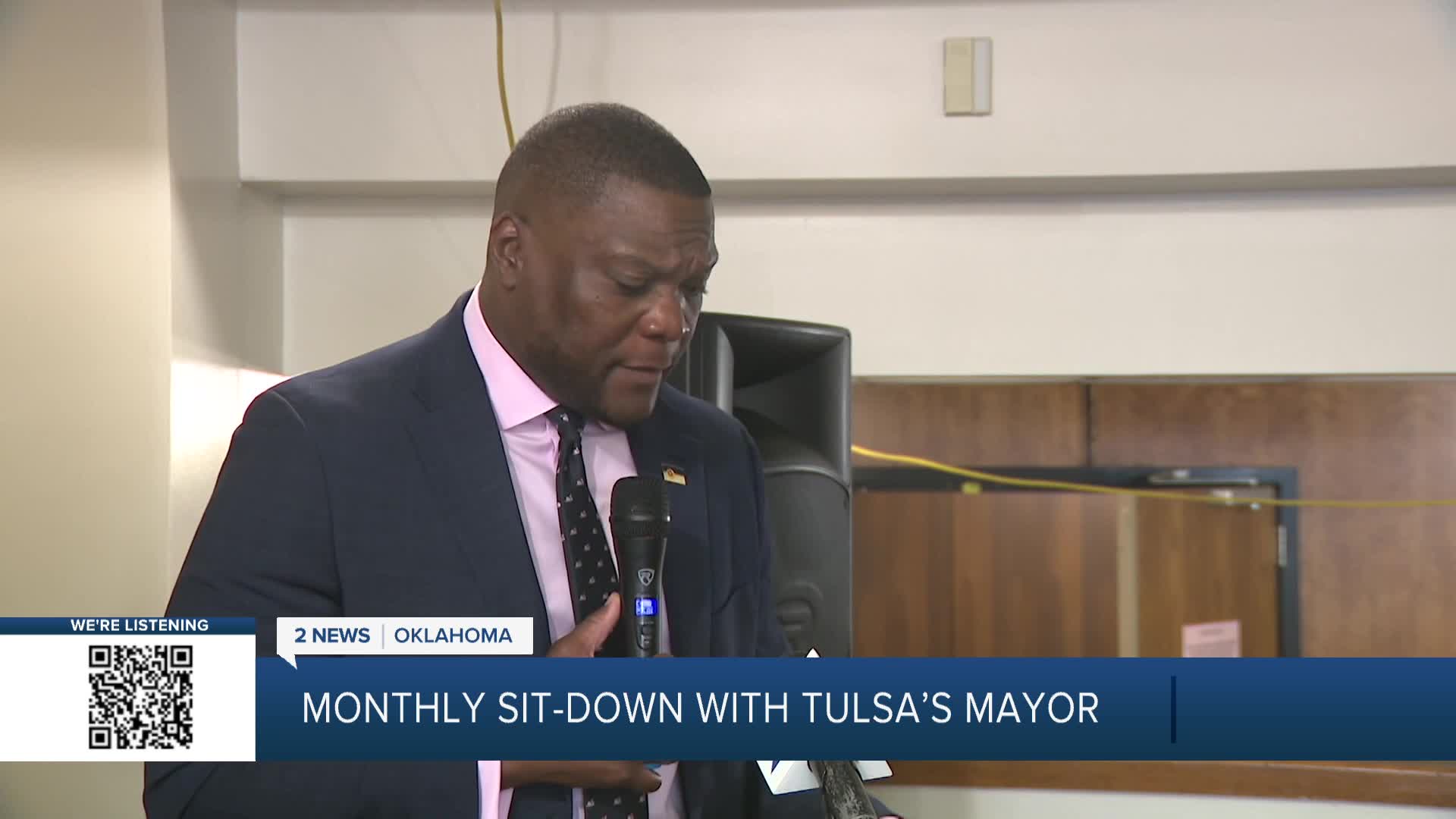



TULSA, Okla. — In our monthly segment with Tulsa Mayor Monroe Nichols, we discuss the Safe Move Tulsa initiative, the city’s first low-barrier shelter, a new downtown police division, and the response to the tornado that hit north Tulsa.
Here is the full interview transcript between 2 News Oklahoma Anchor Naomi Keitt and Tulsa Mayor Monroe Nichols:
NAOMI: I want to start with the most recent announcement that you all made. 118 people off the streets of Tulsa with the Safe Move Tulsa Initiative. Walk me through what that means for the people who now have homes and then our community.
MONROE: It kind of starts when we, you know, first came to office. Big priority was reaching functional zero by 2030 and really figuring out we have a community that's invested in the private philanthropic side in homelessness and so a great network of providers. The question was what was missing and being aggressive about getting people out of encampments, getting aggressive about street sleeping, connecting people to services and making sure that we have this real contribution to the overall system. That's what Safe Move is and so to date we've closed 6 encampments that haven't come back. The 118 people that you mentioned are the 68 initial and the 50 just recently out of downtown alone. I think what it means for our community is that we're showing that even on a tough issue, an issue that is, you know, every city in America is dealing with, an issue that has been around for a very, very long time and very persistent, we can make real progress. So what it means for the people who, those 118 and a number that's growing who are off the streets now, it means a shot at, you know, a reset for life. I mean, you know, there's some amazing stories of folks who, in the first round that kind of first group of 68 who've gotten housed. They've got the supports they need, uh, several of them have been able now to afford their own car and they're able to get around and get connected back up again. So that's what this is all about. It's about certainly cleaning up our streets, but it's also about making sure that we're not doing it in such a way of haste that we're not looking out for the individual. Everybody who we encounter on the streets with outreach workers has, you know, sort of an individualized plan. So, if you have a challenge that's a substance abuse challenge or a mental health challenge or maybe it's just like a financial challenge, we see a lot of people, most cases can be resolved really in some sort of rapid resolution. These are folks that are having a tough spot, uh, we can help them, we can help them get there. So, it's all about showing people on the streets that we are a city of compassion. Um, but we're also a city that, that wants to be aggressive about helping people along the way, and that's what Safe Move is about. That's what the entire Way Home for Tulsa continuum of care is all about. So, we're really happy to be a contributor to the work. The goal is still to get 300 from Safe Move Tulsa alone off the streets this year. And then with this rapid exit strategy that we'll be talking a little bit more about uh in the coming weeks to get 1000 people housed this year. So last year, you know we hit, 1000 plus with the Way Home for Tulsa Continuum. We're trying to level it up even more. The inflow every year is about 3000 people become homeless in this community. We're trying to get to a place where we can take about a chunk of 2000 out of that by getting people housed aggressively and very rapidly.
NAOMI: That's that phase two of the Safe Move plan. How is it going to get paid for?
MONROE: We right now, we invested 6 million in Safe Move to get it started for phase one. The private sector, you know, really appreciate the Tulsa Leadership Council for a $4 million commitment, the Zarrow Foundation, a million dollars commitment to that work. We'll make a similar investment this budget year and then working on what really is a big chunk we'll need, um, in future budget years so we remain committed to it. Yesterday, you saw I was there with 4 councilors, so both the mayor's office and the city council are really taking this seriously and know we have to investigate the outcomes.
NAOMI: So that this is a program that can continue?
MONROE: I mean you gotta, you gotta stay with it, right? It's just like everything else that we do. I mean you, last year we had record lows when it came to crime in all major categories, but you don't shut down the police department because you have one good year, right? You really have to stay on top of these things and make sure you're building a system that is focused on some outcomes and for us it is where the intersectionality of our affordable housing comes into place, making sure that, you know, the number of affordable units that we have is more than the inflow every year of folks who are homeless. So, as an example, if we got 3000 people falling into it, we need to have 3,001 available units, right? Just to stock there, making sure that the people who we serve aren't homeless again. So, every 2 years we're checking to make sure that less than 5% of the folks are homeless that we serve, so we have a 95% success rate is the goal, which I believe is an important goal. Then the other one, which is really, really important, is making sure that housing wait time is 45 days or less. Uh, right now or last year historically that number's been around 220 days and so reducing that down, those three things are kind of a guiding light for us when we think about how the system's working.
NAOMI: I think about just over the course of the last month I've kind of been clipping headlines. The Harbor has been one of those headlines. Big deal. Talk to me about how that plays into all of this.
MONROE: It's huge. I mean if you think about one of the challenges when I came to office was that our shelters were about 110% capacity which is tough. I mean that means there are people at those shelters, you know, almost sleeping in hallway type stuff because they're they got a packed room. So, we had the winter weather shelter that we had this winter that serves 600 people. The Harbor is going to be a shelter that can serve 180 in any given time and it being low barrier nature meaning that the folks who we encounter on the streets every day, we can get them rapidly into a shelter and be able to work the magic from there, which is critically important. So, the Zarrow Foundation, the Ruth Nelson Foundation have stepped up huge to split the cost on that. It is one of the great examples of a public-private partnership that you'll see anywhere between us, those two foundations, um, the county. We're all working together to make that happen, and there's going to be a ton of people whose lives will be much better off. The important thing about the shelters too. I think this is important to, to mention this organization. The operators matter and so we have an amazing operator in City Cares who's already here starting the work, the preparation work, and by the end of the year that low barrier shelter will be up and we'll have folks in there.
NAOMI: Talk to me about what low barrier means. What's the difference between that and what we already have in downtown Tulsa?
MONROE: I mean some shelters, have some sort of criminal thing there, you know, there's restrictions there or some are men only, um, or some are you can't have a substance abuse, those types of things. A low barrier shelter truly means low barrier, so you can get in there and there's all the precautions are there and these are really safe environments where folks can come in and get what they need no matter how they come to us. I can tell you it's true that even the folks who we encounter on the streets right now, some of them do have some trouble that we have to help them navigate. Housing them can be difficult. Uh, the low barrier shelter helps with that, so we can begin to work that. When I talk about folks who may have a criminal record, I think it's really important for us to think about the through line here in Oklahoma, a state that, you know, through the vote of the people passed criminal justice reform. So, we have to keep that reform mindset even with this population and not necessarily say because they're homeless and they have a record they're a problem. It's really how do you help them work it because sometimes just the cleaning up that particular issue is the barrier to housing, right? Um, these are folks that, you know, but for some of those challenges would be fine. So how do we help them get to a better spot? A low barrier shelter helps you with all the breadth of all the people who might need support. So, if you think about all these things as tools, tools in the toolbox. Before I got elected, the 3H task force, they recommended we need a low barrier shelter, and what we're going to have is a first class low barrier shelter that I think will be the best in the state for sure.
NAOMI: You touched on crime just a little bit. I wanna talk about the new downtown police division. Um, I know that there has been some instances of crime in the downtown area. This is supposed to address that?
MONROE: Yeah, I mean, I think we've done a decent job of handling public safety downtown, but I think the big thing is you gotta recognize downtown is almost like a little city within the city, and right now we end up pulling from other divisions to address public safety issues downtown. Having it anchored here is going to help with a couple of things. One, response times, but two, just the visible presence and I think as we think about the big events we have the BOK Center or we think about, you know, just the weekends where we have a lot of young people on our streets, I think having officers there engaging in ways that they engage in other parts of the community is actually going to help reduce some of the challenges that we see. I think that's everything from, you know, kids wanting to fight to, you know, people maybe not following all the traffic signals, leaving the event and everything in between, whether it's the conferences that we have and everything like that. I think it's really important that we get that done. It won't be up and going until the fall, but the preparation, how we get there is we're knee-deep in it right now.
NAOMI: I see your I voted sticker. TPS has a huge bond issue on the ballot today. When this runs tomorrow, there's a chance that that could be passed.
MONROE: I sure hope so.
NAOMI: What does that mean for this community?
MONROE: Well, it means so much. I mean, you know, I'll almost say like, hey, no matter how you think about this is a big deal. If you spend any time in schools and you look into the eyes of young people at any age and you ask them what they want to be when they grow up, voting in this election, to support this bond is helping them get closer to whatever dream that is. If you think about it separately, say you don't have kids in public school, uh, say you don't have kids at all, but say you're a business owner, uh, and you're thinking about a long-term workforce. You can't get there unless we get this right and then we think as an entire community, I think there are folks who look at those things and it’ll be on the front page of the newspaper tomorrow. You guys will cover the success or failure of the bond. People who read about a community that invests in itself is a community that people want to be a part of and live in. So, so I think whether you think about it from the standpoint of making sure that every kid has an opportunity, whether you think about the economic vitality of the community, or whether you think about quality of life and being in active city for other folks there are all the reasons in the world to vote yes for it. Uh, the career academies that are included in it, I think are critically important. The investment in music and STEM education, I think is incredibly important. One thing that as a parent who had to send his kid out to Bixby for driver's ed, bringing back driver's ed is in there, which is really, really important. And then making sure the district can take care of the facilities that it has. I can tell you, being mayor, we own a lot of buildings in the city. Taking care of the buildings that you have is critically important and so making sure that young people are in an environment where learning is made easier and more comfortable, I think it's really important and this bond does all those things.
NAOMI: Within the last month we had a big tornado that came through North Tulsa. I was very impressed by the response from a lot of our community organizations who hit the streets right away. What was the city's role in all of that?
MONROE: Yeah, I mean, you know, it was really interesting. Uh, I was actually sitting in my office as the storm was blowing in. Laurel Roberts, who is the public safety commissioner but also our emergency management director was in the emergency operations center, and we were monitoring it the whole way. It was a bizarre storm because the neighborhood around, Tulsa Tech, for example, or the neighborhood around, uh, Greenwood Academy largely unimpacted particularly when you think about the contrast between what happened to those two facilities and so we were able to mobilize really quickly. There was a gas leak on 36th Street North, and the police department blocked off, fire department along with ONG took care of it. We were able to deploy the things that we had to deploy pretty quick. But to your point, what was the coolest thing about the storm were people just the community, the next day just got to work cutting trees down, doing all the things. We opened up our dump sites so people could, you know, haul things off, but man, how people came together so quickly. It was, I mean, it’s one of those things that kind of warms your heart a little bit, but it's also like, man, does this happen anywhere else? I'm not sure that it does. I mean it was phenomenal.
NAOMI: I know going out there and talking with people, they said hundreds of people I didn't know came with tarps and it was crazy, saws and everything.
MONROE: That it's like they woke up like people knew, oh, there's, there's a storm. Let me get on up, get my stuff ready, and let's go. It was amazing.
Stay in touch with us anytime, anywhere --
- 2 News Oklahoma on your schedule | Download on your TV, watch for free. How to watch on your streaming device
- Download our free app for Apple, Android and Kindle devices.
- Like us on Facebook
- Follow us on Instagram
- Watch LIVE 24/7 on YouTube
