

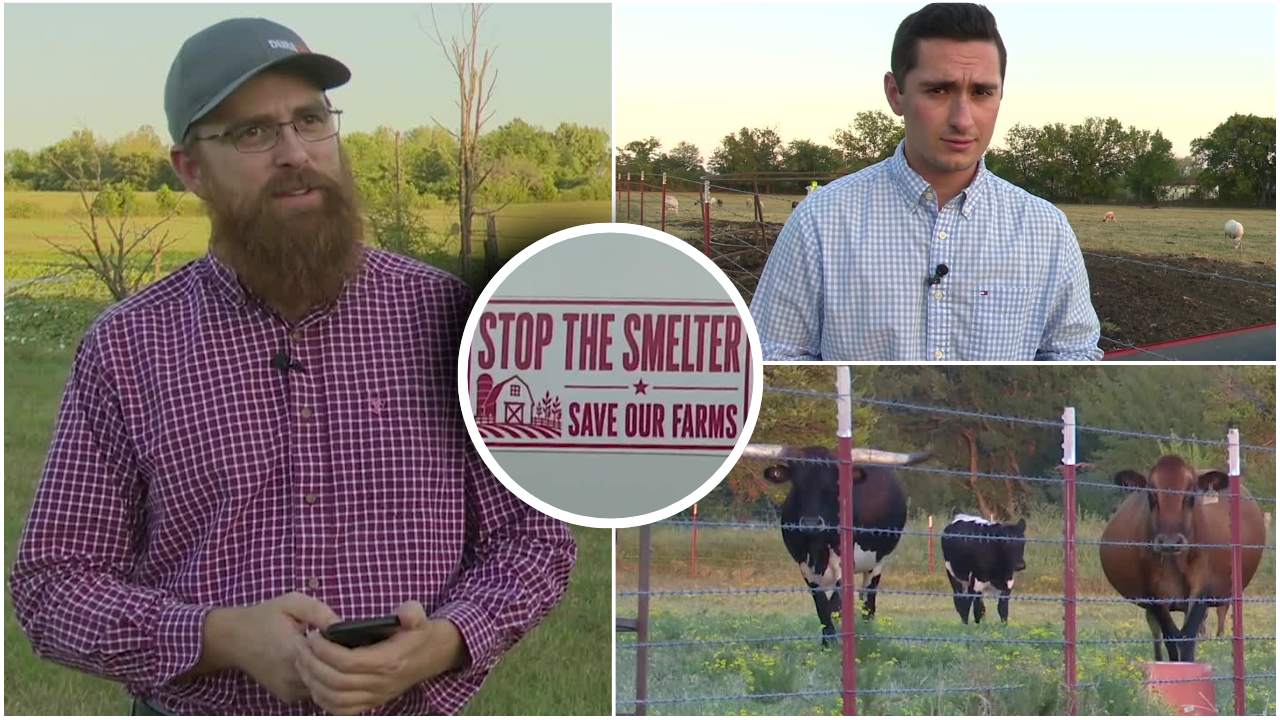


INOLA, Okla. — After emissions plans for the proposed Inola aluminum smelter got modifications submitted to the state's Department of Environmental Quality, an Inola rancher said he analyzed what that might mean for his land and livestock.
Steven Flathers will tell you he doesn’t have nearly the biggest Inola hay ranch, but he does have a lot of his own research on Oklahoma Primary Aluminum's parent companies' smelters in other parts of the world.
“It’s one thing if they’re going to come in and actually do it the best in the world," Flathers said. "It’s another thing if they say they’re going to do it and then not do it.”
Flathers refers to 2 News' Sept. 3 interview with Century Aluminum Senior VP of Strategy Matt Aboud, who boasted new projections of lower industrial fluoride fumes and dust.
- Previous coverage>>> Inola aluminum smelter fight: Courts grant Drummond motion, rule on petitions
“The total fluoride emissions is calculated based on this new .64 pounds-per-ton (multiplied by) 773,000 metric tons per year,” Aboud said of the plans.
“In my opinion, sure we’re cleaner on a per-ton basis. But (with) the scale of this project we’re going to be producing 55% more fluoride here in Inola than is released from the Kentucky facility," Flathers told 2 News. "And I think that that deserves a much harder look.”
While the landowner advocates for more regulatory testing, he said he’s picked a side in the meantime.
“Something that gets thrown around is a lot of those who may oppose this project is, “Oh, you’re just a far-left-leaning, crazy environmentalist,’" Flathers said. "Really, I think this is just a commonsense approach. There are studies throughout the world, especially at some of the cleanest smelters in Norway making as little as 85 tons of fluoride annually, where they’re seeing fluorosis in 42% of deer around that facility. I can’t help but wonder how can three or four times the annual fluoride not have an impact on the cattle here?”
2 News also received reaction to the updated OPA submission to DEQ from an Oklahoma City-based environmental consultant, Dr. Charles Marshall:
The Press Release is different from the submittal they appear to have submitted to DEQ AQD. I will wait to see that document and the corresponding DEQ response before I conclude that this projected Fluoride air emission reduction results in any real improvement in the Fluoride emissions that may impact surrounding ranches and dispersed to the ambient air.
I trust the great professionals at the DEQ. Their scientists and engineers are doing an excellent job scrutinizing the Construction Permit application.
It will come down to a mass balance of Fluoride-in (alumina from the 1,000 barges a year) and cryolite-in (particularly important to the process), versus Fluoride-out and the capture efficiency of their controls.
The real impact from an air pollution perspective may not be fulling known or set in as Operating Permit Conditions until the subsequent testing is conducted to certify the emissions. Fluoride is only a small part of the Smelter’s air emissions; criteria pollutants and its climate changing CO2 emissions still need to be evaluated further by DEQ. We need DEQ to oversee and verify these emissions regardless of what the OPA modeling or “Press Release” predicts.
So, the next argument will entail, where does all the elemental Fluoride go (scrubber waste, bag house dust removal, spent electrode hazardous waste and wastewater discharge to the new Port of Inola wastewater plant)? Will it add up and does it really mean the Fluoride that lands on the forage and ranches nearby this Inola Smelter will have “no adverse impact?” It is a conservative parameter, as Fluoride does not degrade once released to the environment. Decades from now where will it all have gone?
 Facebook
  TikTok
  YouTube
 Instagram
 Threads
 X
X