

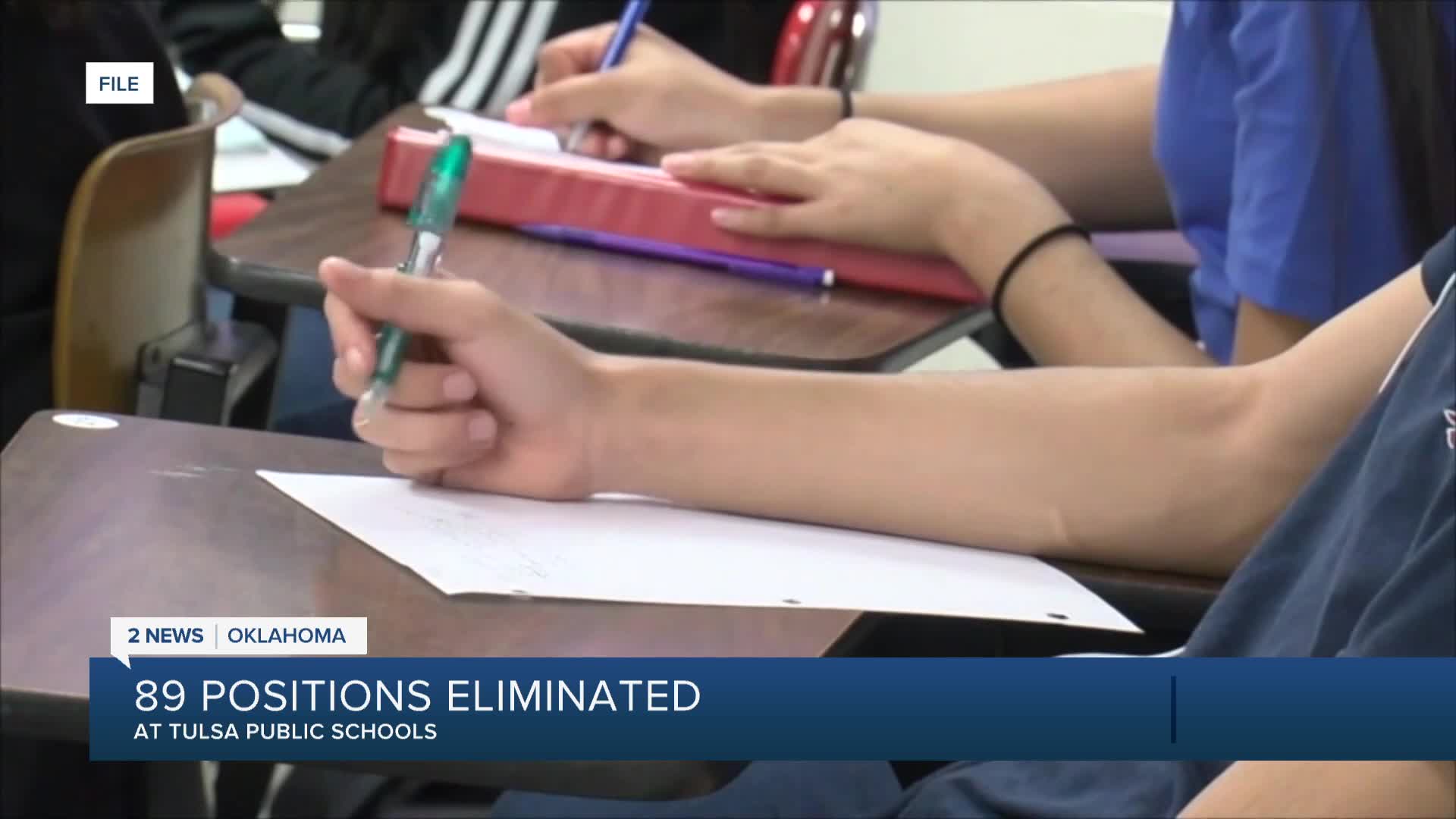



TULSA, Okla. — The Tulsa Public School board approved eliminating 89 positions at its March 24 meeting.
They are eliminating 50 employee contracts as of June 30, and 39 vacant positions. The district also created 13 new positions to consolidate some of the responsibilities of the eliminated jobs.
WATCH: Tulsa Public Schools approves cuts to 89 positions:
2 News Anchor Naomi Keitt talked with the district’s Chief Strategy and Innovation Officer about these cuts. Their conversation that follows was edited for clarity.
NAOMI KEITT, 2 NEWS ANCHOR: I can only imagine how difficult eliminating positions is for anybody, specifically a school district like TPS. I wanted to start by asking why these eliminations are necessary for the district in the first place?
SEAN BERKSTRESSER - CHIEF STRATEGY AND INNOVATION OFFICER, TULSA PUBLIC SCHOOLS: "Definitely, you're spot on. I mean, we have people that dedicate their entire lives towards serving students, right? And, and we do, we have people that do that in all sorts of different capacities and different jobs and tough decisions. So the primary driver of revenue for school districts is enrollment, student enrollment, and not only is enrollment declining, TPS has actually lost students this school year compared to last year. It's declining across the state. I think the state as a whole in Oklahoma is about 11,000 down. But national research is suggesting that we'll continue to see student enrollment declines in public ed over the next 10 to 20 years."
"I'm probably going go more in the weeds than is necessary, but declining birth rates are really a big driver of that. When enrollment declines, our revenue declines, and we also have been successful at filling more and more of our vacant roles over the last few years, which is a good thing. Like these are not only teaching positions. We’ve had far fewer teacher vacancies this school year, for example, but bus drivers, school support roles, we've filled a lot more positions over the last few years that have added a lot of value to schools, but we have a situation over the last few years where student enrollment has declined and our number of filled roles has actually climbed up. Um, so we're not in any sort of financial crisis at all right now, but we will be if we don't act over the coming years and just make sure that our spending is more in line with our revenues that we're bringing in any given year."
"Based on our projections over the next few years, we know that we need to kind of lower our spending and 90% of our general fund expenditures are salary and benefits. So we're doing everything we can to be very smart about non-salary costs, contracts, supplies, you know, anything like that. You know, people really are where the bulk of our general fund spend."
NAOMI: How specifically do student enrollment rates correlate with how much money is coming into the district? What correlation do those two have?
SEAN: "The Oklahoma State funding formula basically provides revenue to districts based on a per pupil basis, and, you know, there's different weights depending on the student's characteristics. So, for example, a student that requires additional supports and special education services, for example, like you get kind of a different weighted funding from the state, but in general, every student equals some sort of per pupil revenue that you're getting from the state. So, there's really a direct correlation there that the number of students you have is directly correlated with the uh funding that you receive from the state."
NAOMI: I want to make sure that I have the numbers correctly from what I've seen reported. It's 50 employees who are currently under contract and then 39 vacant positions that are being eliminated. Is that correct?
SEAN: "Yes, that's correct. The only thing I would say is that, so 50 people, there's 39 like unique positions that were eliminated. 3 of those had multiple roles, so 42."
NAOMI: Talk to me about how those positions specifically were decided that they could be eliminated.
SEAN: "This was entirely about making difficult trade-offs. This was not about the quality of job performance or anything like that. That this is really just about trying to keep a few key things in mind as we made trade-offs. So, number one, these roles are, are all district office positions. So yes, they serve schools, right? But it was important to us this spring to start like very clearly with district office roles and try and protect school site investments as much as possible for next school year. Within that, we try to sustain roles that are directly providing academic support to schools. Student achievement is our number one priority. We're really proud of the progress Tulsa Public Schools is making and, and our schools, our school leaders, our principals, our teachers, our support staff. We're just seeing student achievement gains across the board, and we're really excited about that, need to continue it. We're, we're trying to protect direct academic supports as much as we can."
"Another thing is, is we looked at duplication of roles and kind of complexity. Part of our goal is really to reduce and streamline the number of roles that are supporting principals, so they just have fewer points of contact and, and less complexity to navigate in terms of I have a specific point of contact that does this."
"I have a specific point of contact that does that. We're just trying to streamline and make it simpler for principals to navigate district office. I would say those were really our key criteria. And then I think the other thing we mentioned to the board on Tuesday night is that we also had some roles that we felt were very valuable in providing meaningful contributions, and we still needed to kind of, I don't even want this to come across as flippant, but like focus on the must-have roles even more than the nice to have roles, even knowing that many of these nice to have roles are adding value. Given our fiscal context over the next several years, like we needed to make sure we could justify investing in some of these positions long term. I'll also just be honest that many of our recommendations that the board approved Tuesday, you could have made a case for multiple of these criteria, like being true for those jobs, and, and we still, I mean, this is getting close to net reduction of, you know, almost 100 roles because there are, there are a very small number of creates that kind of corresponded with what they approved, but it's a pretty large magnitude at district office."
NAOMI: You talked about a couple of positions being added. Is it 13? Is that correct? Talk to me about what that's going to look like, and then what it means for potentially some of those people who are going to be out of work this summer.
SEAN: "There were 13 created roles that the board approved Tuesday night in addition to the, you know, around 90 eliminated positions. It's just the case that for a lot of these eliminated roles, we are just not going to be providing the same level of service. But there were 13 created roles that were meant to help kind of consolidate different functions and account for new responsibilities in some cases kind of joint responsibilities between different roles that were, that were eliminated. Many of our employees that were in these affected roles would be great candidates for the new positions and we're actively encouraging them to apply, If anybody was at the public board hearing, the individual that was actually appealing their position would be a candidate that's qualified for one of the new created roles, just as a very specific example."
"In net, like this is a loss of many, many positions at district office, but we do hope that many of these employees are either interested in new positions or seek out other roles because we do still have other vacancies that are part of Tulsa Public Schools budget for next year. Whether that's school site roles, there are some currently vacant district office positions, and then the board approved the 13 new positions."
NAOMI: How much money is this expected to save the district?
SEAN: "So, between these recommendations, as well as non-salary budget cuts that we're trying to make true for next school year, all of that is, is adding up to our anticipated savings of about $7 million in spend for next school year. The positions are part of that. We also have non-salary costs that are part of that, but it's all part of kind of a $7 million anticipated reduction."
NAOMI: I know when we started this conversation, you said that this is really about futureproofing to make sure that you guys are not in a crisis in the years to come. Is this the last set of cuts we could see, or is there the potential for more cuts next year?
SEAN: "Yeah, there's definitely the, not only the potential, but the need to continue to make good smart cuts over the next few years. And again, I want to reiterate, we're not in any sort of financial crisis. We are trying to act responsibly to avoid that in the coming years. There's a lot of tools that we have at our disposal though, right?
You can kind of manage attrition over time and just be intentional about backfilling roles or not. We can continue to be very judicious with our department budgets and non-salary spends across the district. We're continuing to try and support principals with maximizing the efficiency of their building schedules, the use of all the adults in their building."
"So. this kind of like ethos of just let's be as efficient and purposeful with our resources as possible, is something that we are just spreading across the whole district with every department leader, every building principal, and every amount of savings that we can find contributes to helping us close that operational budget gap, operational deficit, I, I guess is the way to say it. We’re definitely keeping an eye on this and we'll need to continue to gradually close that gap between our spending and our yearly revenues to make sure that we're not eroding our fund balance too much. Our fund balance is basically like our savings account. It's the money that that we have in the bank, so."
NAOMI: Was the vote this week, was that the final decision, or is there any other votes that need to come up before this is finalized?
SEAN: "Yeah, good question. That all of the recommendations for those positions that we talked about, those were actually finalized on Tuesday night. So, the individuals, those 50 individuals are in their current positions through June 30th. That's how long this fiscal year goes. The decisions the board approved would take effect July 1."
NAOMI: Is there anything that I didn't ask that you think that um our viewers need to know when they see this?
SEAN: "We also have a bond vote coming up on April 7th, and we are very excited about the package that we put in front of voters and are excited about all of the opportunities that can create for students in the building and facilities improvements.
I want people to know that our cuts at district office are really meant to help ensure that we are being as responsible as we possibly can with our resources and we are continuing to become more and more efficient and more and more fiscally responsible in terms of making sure that our spending is in line with our revenues. The bond investment is a part of our charge to bring, you know, our responsibility as we're bringing a vote to voters to approve another bond package, right? We owe it to our voters to make sure that we are shoring up our own spending and making sure that we're operating as efficiently and effectively as we can."
"I think some people might be wondering like, oh, how does this come into play with the bond vote? And they're different things like our general fund is really how we operate as a school district, how we pay our staff, etc. The bond expenditures are capital expenses, building improvements, technology, curriculum, you know, driver's ed programming and, and driver's ed cars. So, we're really excited about all that, and we want to make sure that we are being as responsible as we can with public dollars as we ask for these bond investments from our community."
"I also just want people to know that TPS is not a sinking ship, like, yes, it's really hard going through these situations and making cuts, but we're on the right track. I mean, we're moving outcomes, whether half of our graduates in the most recent class left TPS not only with a diploma, but with some sort of post-secondary credit or workforce credential that they could immediately apply. We've increased proficiency rates on the state assessment in every single grade level in reading and math over the last two years. That's happening at the time the state as a whole is declining. Teacher vacancies are down, like we talked about. Student attendance is getting better. I just want people to know that it’s tough talking about budget cuts, but our district is continuing to get better and our, our staff across the district are the reason why, right? And we're just really excited about all that."
Stay in touch with us anytime, anywhere --
- 2 News Oklahoma on your schedule | Download on your TV, watch for free. How to watch on your streaming device
- Download our free app for Apple, Android and Kindle devices.
- Like us on Facebook
- Follow us on Instagram
- Watch LIVE 24/7 on YouTube
