

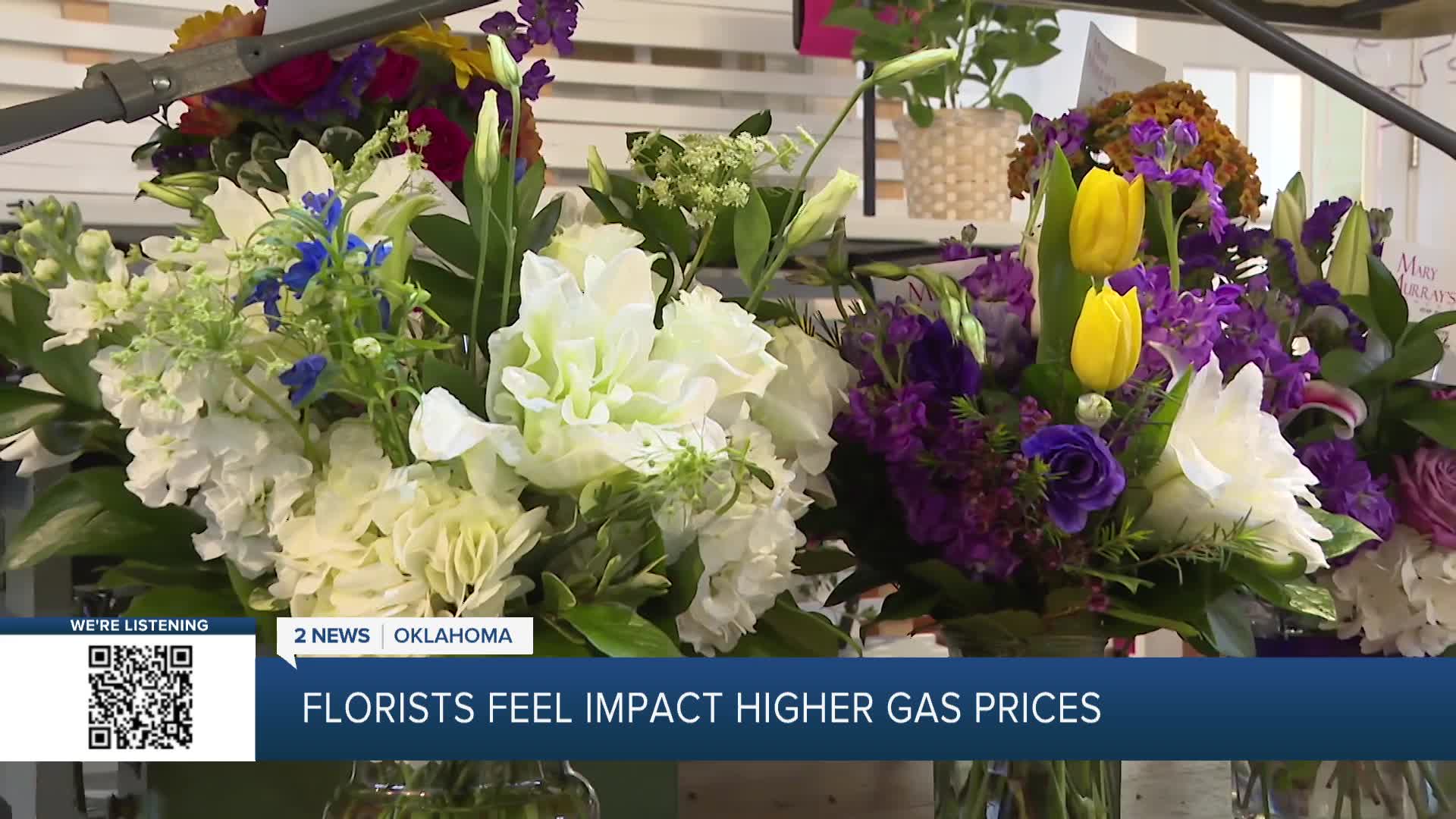


TULSA, Okla. — Mother's Day is considered the Super Bowl of the floral industry, one of the three busiest holidays for flower and plant purchases and deliveries, according to Fortune Magazine.
This year, Tulsa florists are heading into the holiday rush with fuel costs cutting into their bottom line from multiple directions.

Scripps News Life
Reasons behind recent gas price swings
Gas prices in the Tulsa area are averaging just under $4 a gallon for regular unleaded, according to AAA.
That's a sharp jump from around $2.50 a gallon in late February, before the war with Iran.

"That national average is up 42% from the same time a year ago," Ted Rossman, a Bankrate financial analyst, said.
At Mary Murray Flowers, designers are hard at work crafting dozens of bouquets ahead of Mother's Day deliveries.
Owner Nicki Argo said her customers are understanding about the pressure higher fuel costs are putting on the business.

"They never complain about our delivery prices because they know, they realize, it hits them too," Argo said.
To manage those rising costs, Argo is rethinking how deliveries are handled.
"We're having to really work hard at being more efficient, running leaner, doing more batching of our deliveries. I didn't want to do limited delivery areas, but the further we get into this, it's harder to go out further without increasing prices," Argo said.
The fuel cost pressure doesn't stop at the local gas pump. Many of the flowers sold at Mary Murray Flowers are shipped in from overseas, making the business vulnerable to global oil price disruptions — including shipping disruptions in the Strait of Hormuz.

"It's definitely impacting us. We feel it on the delivery side as well as the supply chain side," Argo said. "The majority of our flowers come from other countries, and so they have to be put on a jet. Sometimes they're put on ships, then they have to be refrigerated and trucked from Miami or LA or someplace like that. So all those increased gas prices and even some of our flowers come from places in the war zones."
Those overseas shipments are arriving with a growing number of added fees.
"Oh my goodness, lots of surcharges. We always have surcharges, but they just keep growing, and, you know, you try to absorb them as much as you can. You don't want to just pass every little cost on to the consumer, but it is becoming more and more difficult," Argo said.
"A lot of business owners feel like they're reluctant to raise prices," Rossman said.
He said the broader economic impact of higher gas prices is significant, even if consumers haven't fully pulled back on spending yet.
"This is very much having an effect psychologically. This is really one of the most visual reminders of inflation, because we may fill up our car once a week and drive past a gas station just about every day. It's a very obvious reminder that prices are going up, and it's contributing to consumer sentiment ratings that are at or near record lows, according to the University of Michigan, the Conference Board, and other indicators," Rossman said.
Rossman noted while the mood around gas prices is gloomy, major banks and credit card companies reported higher fuel costs haven't yet led consumers to cut back on other spending, such as travel and dining.
"There has to be a tipping point somewhere out there. We probably haven't reached it yet," Rossman said.

He said the Bureau of Labor Statistics reported in its last consumer expenditures report that the average household spends around $2,400 a year on gas. A 42% increase would add roughly $1,000 to that annual total — less than $100 a month for most households.
"So is it enough to really change the calculus? It's often less than 3 or 4% of the household budget. But then again, we see stats showing that half of Americans don't have $1,000 saved for an emergency. So the impacts here are going to be felt most acutely at the lower end of the income scale," Rossman said.
For now, Argo said she is doing everything she can to protect her customers from the full weight of those rising costs, but acknowledged that may not be sustainable indefinitely.
Stay in touch with us anytime, anywhere --
- Download our free app for Apple, Android and Kindle devices.
- Sign up for daily newsletters emailed to you
- Like us on Facebook
- Follow us on Instagram
- Watch LIVE 24/7 on YouTube
