

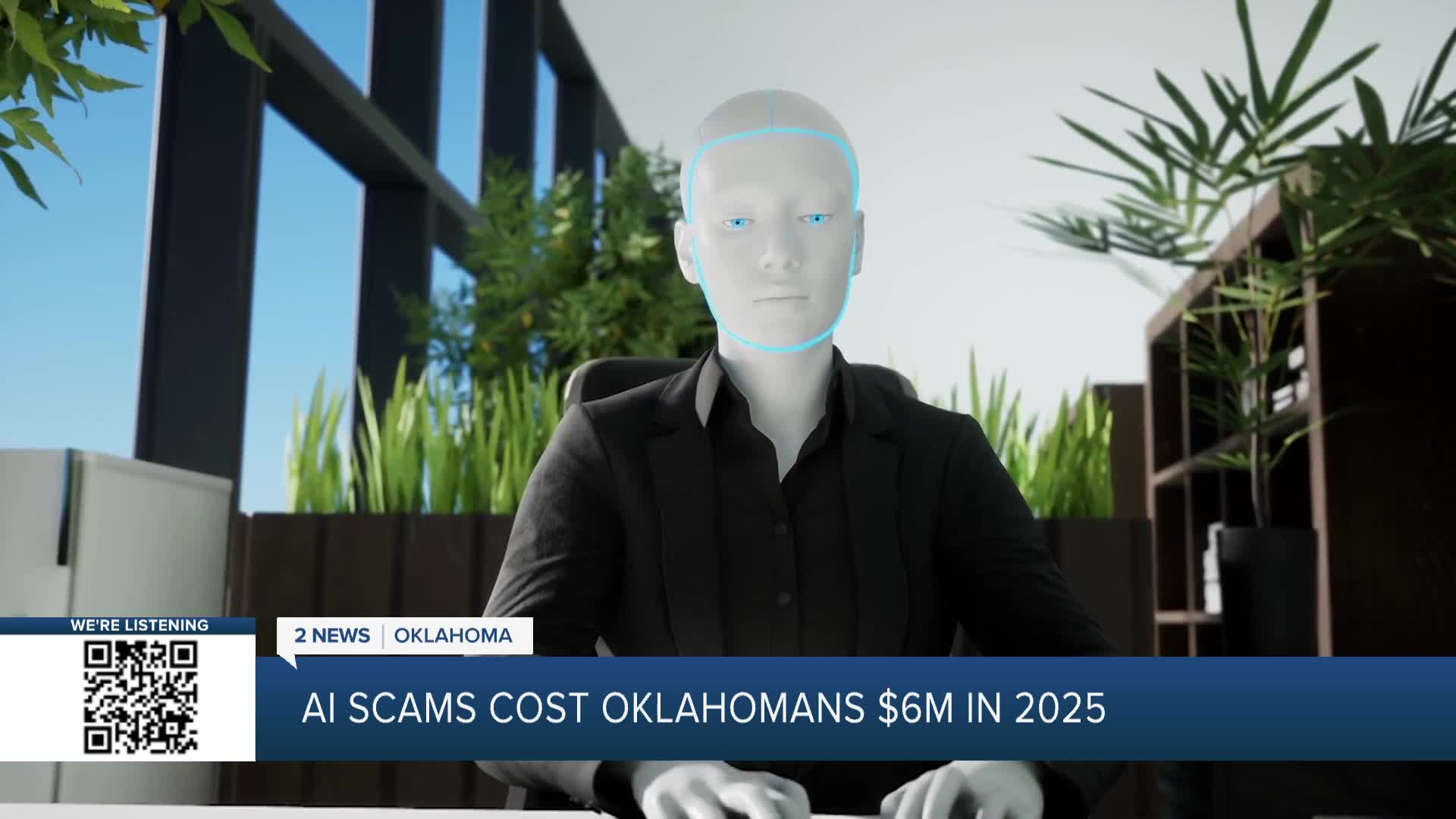


AI-generated scams are surging across emails, texts and video calls — and Oklahomans are among the hardest hit in the country.
When financial research firm Broker Chooser analyzed U.S. official fraud reports for 2025, it found Oklahoma in scammers cross-hairs.

"Oklahoma does come in the top 10 with an incident rate of about 68 per 1 million people. Unfortunately, with a total net loss of about $6 million," Broker Chooser Senior Analysts Brandon Bovey said.
The number of victims appears small, but experts said many targets of AI scams never report their losses — something scammers count on.
The costliest AI-related frauds reported by victims in 2025 involved business email compromise, which collectively cost victims more than $30 million. Tech support scams and romance scams each collectively cost their targets more than $19 million.
Bovey said one way to identify whether the person calling you is real or an AI-generated bot is to pepper them with unexpected questions.
"You could try to ask the rapid-fire questions and see to what extent you're able to get back a reasonable response quickly," Bovey said.

He said algorithms often cannot adapt and respond the way real people can. Tulsa resident Cody Mahon told 2 News Oklahoma he uses this tactic.
"I've asked them who's the president or about current ongoing conflicts and see if they answered to that. If not, then I know it's either a scam or AI," Mahon said.
On video calls, Bovey says to watch for visual inconsistencies.
"Do the eyes and lips make sense? Are they moving naturally?" Bovey said.
If they are not, it is likely an AI bot— not a real person.

The Federal Trade Commission urges anyone targeted by a scam to report it at reportfraud.ftc.gov. Reports can also be filed with the FBI's Internet Crime Complaint Center.
For those who lose money to these schemes, the outlook is grim. 2 News asked Bovey if victims ever recover money lost to AI scams?
"Almost never, and that's the saddest thing. Typically, it's going to be an international wire. It'll be unrecoverable. So, it's just, yeah, the loss rate is close to 100%," Bovey said.
This story was reported on-air by a journalist and has been converted to this platform with the assistance of AI. Our editorial team verifies all reporting on all platforms for fairness and accuracy.
Stay in touch with us anytime, anywhere --
- Download our free app for Apple, Android and Kindle devices.
- Sign up for daily newsletters emailed to you
- Like us on Facebook
- Follow us on Instagram
- Watch LIVE 24/7 on YouTube
