



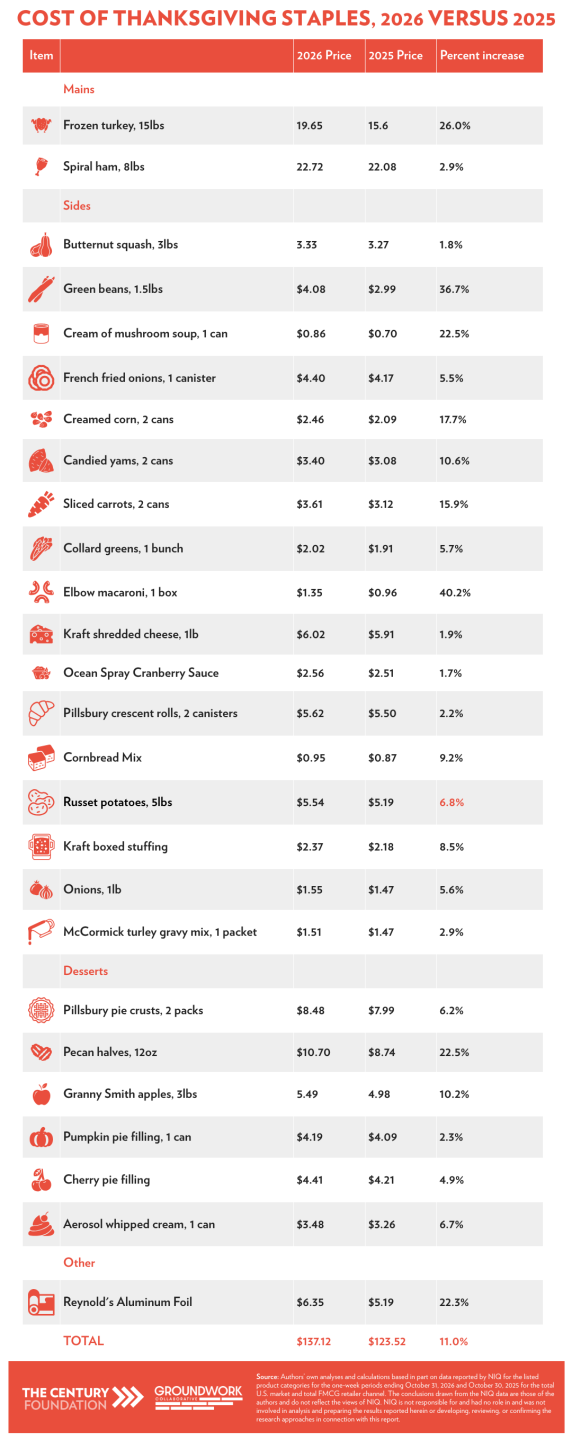
A standard, home-cooked Thanksgiving dinner will cost significantly more to procure this year than it did in 2025, according to a new economic analysis of grocery prices shared first with Scripps News.
Some Thanksgiving staples are only seeing modest price increases from last year, according to the analysis: an eight pound spiral ham will only cost about three percent more and a can of cranberry sauce about two percent more. But other goods are up substantially as compared to their average costs in 2025: a pound-and-a-half bag of green beans is up nearly 37 percent, and a 15-pound frozen turkey is up 26 percent, the analysis found.
Taken together, an average Thanksgiving dinner will cost roughly 11 percent more — nearly three times the overall rate of inflation — according to the analysis from left-leaning think tanks Groundwork Collaborative and The Century Foundation. The report relied on data from NielsenIQ, a global consumer intelligence company, showing average prices for the one-week periods ending in October 31, 2026 and October 30, 2025.
“The prices that your typical American family is going to pay for their Thanksgiving dinner this year have gone up,” said TCF chief economist Kyle Moore. “That is a continuation of a trend that we've seen throughout the year, where inflation is pretty much hitting everywhere.”
“It's just kicking off a very expensive holiday season,” echoed Emily DiVito, senior advisor for economic policy at Groundwork Collaborative.
Causes and effects
Officials said the Iran war and Trump administration’s trade and tariff policies were mostly to blame for the cost increases.
Even as oil exports through the Strait of Hormuz have risen, prompting a subsequent decline in gas prices, diesel and fertilizer costs remain elevated from prewar levels — impacting most agriculture products and anything that requires transportation on a truck.
Increases in the price of canned goods, meanwhile, can be mostly attributed to tariffs on foreign aluminum, though some products like alcohol and cheese are also impacted directly by foreign import duties.
And overall volatility in the global marketplace means sellers are more likely to maintain elevated prices even as some input costs may be falling, experts said.
“Just because there might be easing tension one week, the next week things can be very different,” Moore noted. “We've seen a lot of variation in terms of what [the Trump administration’s] approach has been to both trade policy and to our interactions in Iran, and so I would not expect there to be a return to some sort of norm in terms of the price level until we saw consistency with respect to those relationships.”
RELATED STORY | Interactive: How to save on holiday décor without skimping on your setup
Turkey troubles
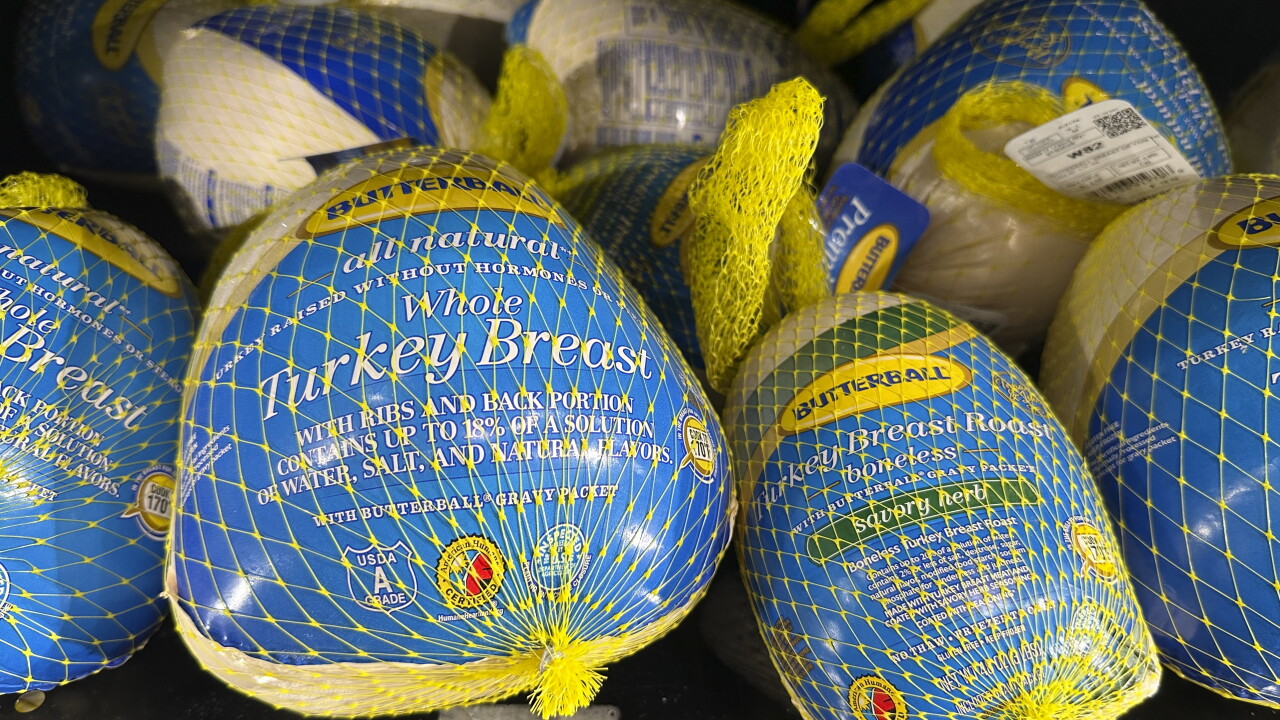
Of particular concern to many Americans may be the cost of a turkey centerpiece. In addition to facing higher fertilizer and shipping costs, poultry producers are also dealing with an ongoing avian flu outbreak — in some cases forcing producers to cull infected flocks, lowering overall supply and driving up costs.
“The number of birds affected has been just enormous,” Dr. Meghan Frost Davis, an environmental microbiologist and associate professor with the Johns Hopkins Bloomberg School of Public Health, told Scripps News. “We're seeing it ramping up, just as it did last year.”
According to data from the U.S. Department of Agriculture, more than 2.7 million birds are confirmed to have been affected by “highly pathogenic avian influenza” in the past 30 days, with October seeing a 324 percent increase in the number of birds impacted from the month before.
Large flock outbreaks “can have a larger impact on the supply chain, and we have seen turkey breeder flocks included in some of the more recent impacts,” Davis said, noting turkeys take significantly longer to bring to market than standard broiler chickens and therefore face longer exposure windows to viral spread.
Some officials, meanwhile, criticized regulatory and staffing changes pursued by the Trump administration, suggesting they hampered the response to the outbreak.
Trump administration officials pursued “research funding cuts and dramatic cuts to the workforces that would be inspecting these flocks and containing these outbreaks,” DiVito alleged. “Avian flu is something that has some kind of biological cause, but the president and this administration are making our ability to weather that, and certainly to ensure that it has minimal impact on the food people eat, even harder.”
A Government Accountability Office report released in early November confirmed significant reductions to USDA staffing since the start of President Donald Trump’s second term, including a 23 percent decline in the number of employees working in the Animal and Plant Health Inspection Service and 12 percent decline in the workforce within the Food Safety and Inspection Service.
Asked about the avian flu, a USDA spokesperson said the Department’s response “reflects the seriousness of this evolving threat.”
“Under the Department’s five‑pronged national strategy, USDA has made historic investments in disease eradication, surveillance, diagnostics, biosecurity, and long‑term preparedness,” the spokesperson added. “Together, these efforts are strengthening the nation’s ability to protect animal health and maintain a safe, stable food supply. Through the HPAI Grand Challenge, USDA is investing over $100 million to fund and support innovative projects aimed at combating HPAI, understanding transmission, and improving biosecurity.”
Pressed on cuts to inspectors and other agency personnel, the spokesperson said, “APHIS continues to assess impacts to staffing and optimize delivery of the Agency’s critical mission to safeguard U.S. agriculture. Our priority is hiring staff to maintain work in mission critical priority positions, utilize temporary duty assignments where applicable, and shifting staff and resources to cover critical mission activities.”
RELATED STORY | Bird flu outbreak raises pandemic concerns as virus spreads across US farms
Higher prices, less support
The increased costs come as many Americans receiving federal assistance are facing new restrictions to their benefits.
The Trump administration and congressional Republicans have pursued broad changes to Medicaid and the Supplemental Nutrition Assistance Program (SNAP), imposing new eligibility restrictions and cutting hundreds of billions of dollars in spending on the programs.
In the year since the passage of the One Big Beautiful Bill Act, a federal law implementing many of those changes, SNAP participation fell by more than 5.5 million, according to an analysis by the nonpartisan Center on Budget Policy and Priorities.
Many of the biggest changes to the Medicaid program, meanwhile, won’t take effect until mid-2027.
Matt Chapman and his sister Amy live in a manufactured home in a trailer park in Waulkee, Iowa. Both are in their 60s and disabled, relying on federal assistance to cover their expenses.
“We have been relying on the food pantry for most of our food,” Chapman told Scripps News.
“She’s been living off like $800 a month and SNAP benefits for years, and then they took her off,” he said of his sister. “It's just going to be a continuous struggle.”
Chapman said the two are likely to go to a nearby church for a free Thanksgiving meal during the holiday next week. He remained hopeful Iowa’s newly-elected Democratic lawmakers would work to undo the federal changes to benefits — suggesting Republicans’ backing of those measures cost them their seats.
“I don't think it's as much that the Democrats won as that the Republicans really lost,” Chapman said. “I would use this last election as a demonstration of just how many people are hurting and how many people are angry that they put their faith in them.”
For those still intending to make a Thanksgiving dinner, experts recommended consumers try comparison shopping — visiting multiple stores to find the best deals — and clipping coupons to save where they can, though they acknowledged some may have to cut back on larger celebrations given the cost.
“People are making tough decisions elsewhere, and that includes maybe doing a slightly diminished version of the holiday, if they are able to host it all,” DiVito said.
